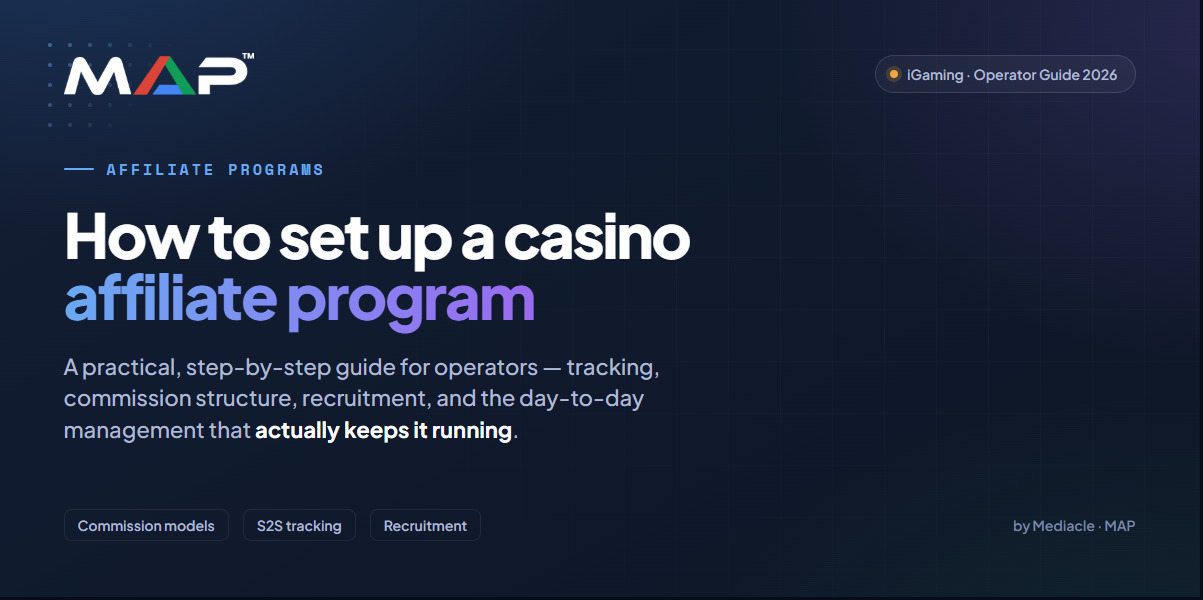
Pretty much every other week, somebody out there drops us a line over here at Mediacle asking more or less the very same question, and it goes something like this: we have got the casino up and running, players are coming in, we are spending a fair amount on paid media and maybe a bit on SEO, but people keep telling us we need an affiliate program, so how do we actually get one started, properly, from scratch, without making the obvious mistakes. And honestly, fair enough. It is a perfectly reasonable thing to want to know and it is one we genuinely enjoy answering, because the operators who come to us at this stage are usually the ones who end up building something really solid, once they have got their head properly round what the whole setup actually involves.
Because the honest truth is that starting a casino affiliate program is not the complicated part, not really. The complicated part is what comes after, the bit where you are actually managing it day by day, keeping your affiliate partners happy, catching the fraudulent traffic before it quietly eats your acquisition budget alive, and scaling the whole thing up without it turning itself into a mess. We have onboarded a lot of operators over the years and years we have been doing this over here at MAP, and the pattern is always more or less the same. The operators who do the setup right, the tracking, the commission structure, the terms, tend to also get the ongoing management right, and the ones who rush through setup because they want affiliates driving traffic by next Tuesday tend to find themselves in a fairly quiet kind of pain about four months down the line when things start falling over. Once the programme is live and you are past the setup itself, our operator’s guide to casino affiliate software covers the mechanics you will end up leaning on every day.
So let us walk through it properly. Step by step, the way we would explain it to an operator sat across from us over a coffee, no jargon, no fluff, just the actual sequence of things that need to happen.
Why Affiliates Are Still One of the Cheapest Acquisition Channels Going#
Before we get into the how, let us take a breath and talk about the why, because it is worth being precise about it rather than just repeating the conference-floor shorthand.
The reason affiliate marketing is cheap compared to paid media is that you only pay when the outcome happens. You are not paying per click or per impression or retaining a creative agency to fiddle with your banner for three weeks. You pay when a real player deposits real money into your casino. That is the whole beauty of the model, and it is why 250 plus of the iGaming brands we work with over here at MAP continue to run affiliate programs year after year, even in markets where regulation is making everything else more expensive and more complicated at the same time.
The trade-off, and there is always a trade-off, is that you are giving away a slice of every player your affiliates send you, sometimes for the lifetime of that player, and if you set your commission structure wrong at the beginning you will either be paying out too generously on players who are costing you more than they are worth, or paying too stingily and your affiliate base will simply go and list with somebody else who is offering a better deal. Getting the commission model right before you recruit a single affiliate is probably the single most important thing you can do at the setup stage, and we will come back to it in a moment.
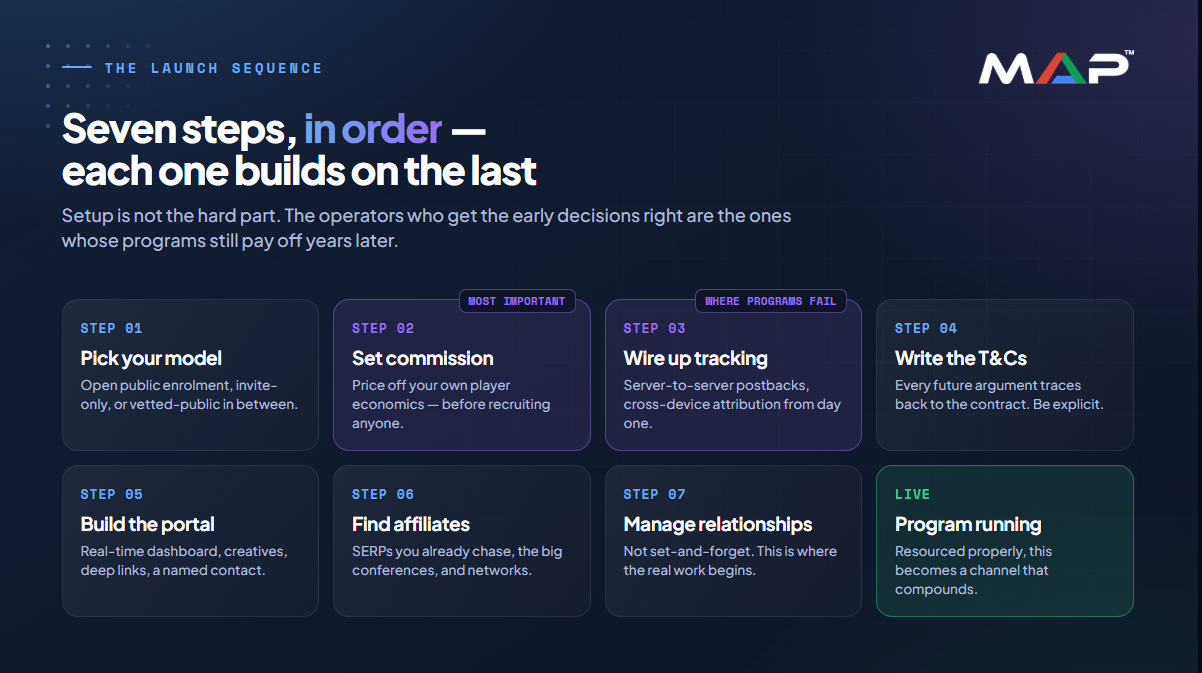
Step 1: Decide What Kind of Program You Actually Want to Run#
The very first decision you need to make is whether you want to run a public, open-enrollment program or a closed, invitation-only one, and the answer is different depending on where you are in your growth as a brand.
A public program means any affiliate can apply, you review the applications, you approve the ones that look legitimate and you decline the ones that look like they are going to send you bot traffic or bonus abusers, and you are away. This model scales faster because the top of the funnel is wide open and in the early days of a new casino, that is usually exactly what you need. You need volume. You need people talking about your brand in review articles, comparison tables and slot-focused listicles. A closed program will not do that for you, not quickly anyway.
An invitation-only program means you go and find your affiliate partners yourself, you approach them directly, you build the relationship before you even open the account, and you only let in the partners you have already vetted in advance. This model gives you much tighter control over brand representation and traffic quality, but it grows slowly and you will definitely feel that slowness in your NDC numbers for the first six months or more. Most operators with a serious SEO-led brand in a regulated market end up preferring this model once they have been running a few years, but trying to start with it when nobody outside your immediate circle has heard of your brand yet is a genuinely hard slog.
The sensible middle ground, and the one we see working the most realistically for newer brands, is a public program with strict application vetting and a probationary traffic-quality review in the first thirty days. Let people in, watch what they send, cut the bad ones fast, keep the good ones close. Simple, honest, and it works.
Step 2: Set Your Commission Structure Before You Recruit Anyone#
This is the bit most operators get wrong, and they get it wrong because they approach it from the wrong direction. They look at what their competitors are offering, they match it or nudge a bit higher, and they call that a commission strategy. It is not. It is just guessing with extra steps, if we are being totally honest about it.
The right way to set your commission structure is to start with your own economics. What is the average first deposit from a player in the market you are targeting? What is the average net revenue per player over three months, six months, twelve months? What is your average cost per retained player, once you factor in bonuses, payment processing, the whole lot? Once you have those numbers actually in front of you, you know what a player is genuinely worth to your business, and you can price your affiliate commission off something real instead of off what the bloke at the next stand in Prague told you he was paying.
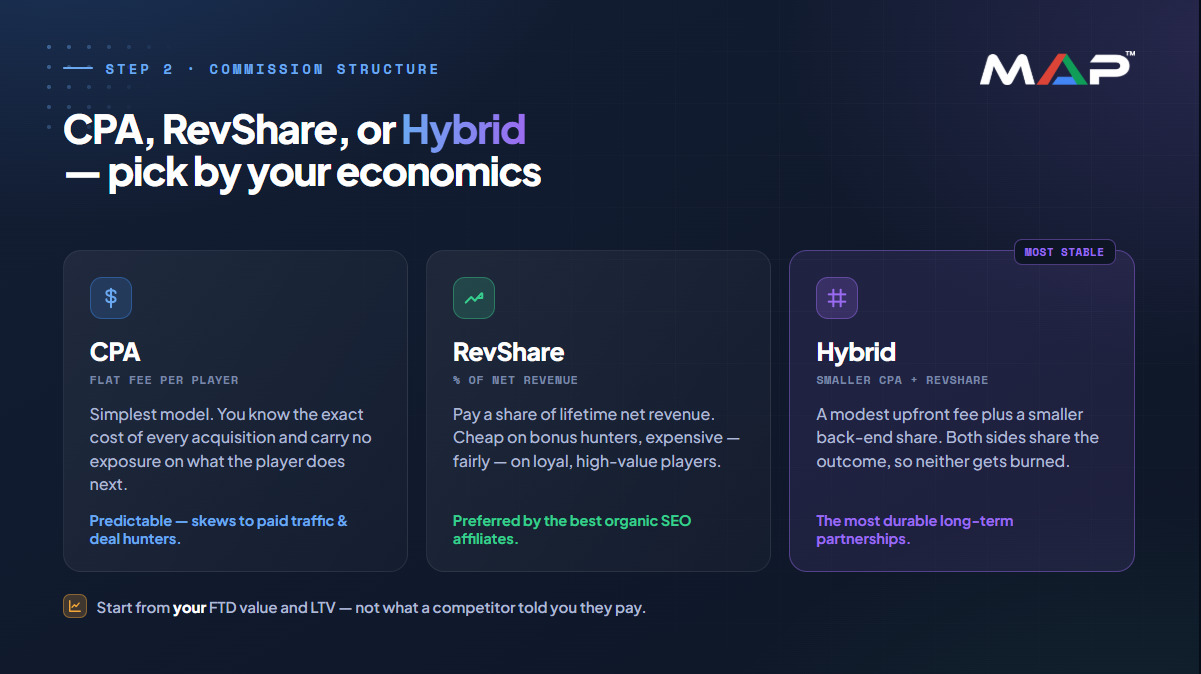
For the commission model itself, you have three main choices, and we go into these in a lot more detail over in our CPA vs RevShare vs Hybrid guide if you want to sit yourself down and read through the full breakdown. But the short version for operators at the setup stage is this. CPA is the simplest model; you pay a flat fee per qualifying player, you know exactly what each acquisition is costing you, and you carry no exposure on what happens to that player afterwards. RevShare means you pay the affiliate a percentage of the net revenue that the player generates over their lifetime, which is much cheaper if the player turns out to be a low-value bonus hunter but expensive if they turn out to be a loyal, high-volume player who sticks around for a long time. Hybrid is the middle ground, a smaller CPA fee together with a smaller rev share percentage on the back end, and it is honestly the model that tends to produce the most stable long-term affiliate relationships because both sides are sharing in the outcome and neither side can be hurt if things go unexpectedly.
One thing we always tell operators at this stage: do not set your rates so low that you are attractive only to low-quality traffic, and do not set them so high that you are paying out more than the economics can support. Both extremes cause real problems, just on different timelines. For a deeper look at how first deposit value relates to long-term player worth, our FTD Value vs LTV article is worth a read before you finalise anything.
Step 3: Get Your Tracking in Place, Which Is Honestly the Most Important Technical Bit#
We are getting into the technical part now, and we will keep it as straightforward as possible, because the details here vary depending on what back-end system your casino is running.
The tracking setup is where a huge number of affiliate programs quietly fall apart, and the worst part is that they fall apart in a way that does not make obvious noise right away. Bad tracking means your affiliates are sending you players who are not being attributed back to them correctly, which means those affiliates are not getting paid for traffic they legitimately sent, which means they are going to find themselves on the receiving end of a very unhappy email from the partners you were most hoping to keep. We have seen this happen again and again and again. An operator launches their program, gets excited about the first wave of signups, and then three months later, they have lost their best affiliate partners because the tracking was misconfigured from day one and nobody noticed until the damage was already done.
What you actually need is server-to-server postback tracking, which is basically a way of passing conversion data directly between your casino platform and your affiliate platform at the server level, rather than relying on browser cookies that go missing all the time, especially in markets where users are mostly on mobile or using private browsing. S2S tracking is the industry standard in iGaming, and there is no sensible reason to be running anything less in 2026. You also want cross-device attribution, because a very large number of casino players will click an affiliate link on their phone and then complete the registration on their laptop, and if your tracking cannot handle that journey, you are going to have a lot of attribution gaps that turn themselves into disputes with your affiliate partners sooner or later.
At MAP we handle all of the integration work during onboarding, and we have done enough of these across enough casino platforms over the years to know where the complications usually sit and to have the connections already built. We do not leave operators to figure that out on their own.
Step 4: Set Up Your Terms and Conditions Before Anything Goes Live#
Boring. Yes. Nobody really wants to talk about this part. But the operators who skip it or who copy-paste a generic T&C from somewhere and call it done are the ones who end up in the most spectacular arguments with affiliates down the line, because all of those arguments come back to the contract eventually, every single one of them.
Your affiliate T&C needs to cover, at a minimum: the commission structure and precisely how it is calculated, what counts as a qualifying player for CPA purposes, negative carryover policy and whether you apply it, the grounds for program termination and what happens to outstanding balances if a relationship ends, what marketing materials affiliates are and are not allowed to use when promoting your brand, and what your policy is when an affiliate sends you bonus-abusing or fraudulent traffic. Each one of those things is a potential argument if the contract is not clear on it, and when those arguments happen, they very often happen publicly, on affiliate forums, on social, and the reputation damage in the affiliate community is not the kind of thing that sorts itself out quickly once it has started.
The regulation side of this matters even more if you are operating in a licensed jurisdiction. UKGC-licensed casinos, for instance, are responsible for making sure their affiliates are marketing compliantly, which means your T&C needs to be explicit about what they can and cannot say and show, and you need a real process for enforcing it rather than just writing it down and hoping for the best.
Step 5: Build the Affiliate Portal and the Creatives They Actually Need#
If you want affiliates to actively promote your casino over your competitors, you need to make it convenient for them to do so. Affiliates are busy people who are managing relationships with dozens of operators at once in a lot of cases, and the programs that make it easy tend to receive the most genuine promotional attention.
The basics that need to be in your portal from day one: a dashboard showing clicks, registrations, deposits, and commissions in real time, not updated once a day or once a week. A range of banner sizes in multiple formats. A deep-link generator so affiliates can link directly to specific games or promotion pages rather than just dumping everyone onto your homepage. A properly documented set of tracking links that they can set up and test for themselves. And a contact point, ideally a named account manager they can actually reach, not a generic support inbox that takes four days to come back with a canned response.
We have seen affiliate programs with genuinely great commission rates, either because the creatives were out of date, the dashboard was running two days behind, or nobody ever replied to anything within a reasonable time. Affiliates will always go where they are treated well and where the tools actually work, no two ways about it.
Step 6: Go and Actually Find Your Affiliates#
Right. You have got your tracking live, your commissions set, your portal built, your T&C written, and you have opened the program for applications. Now you need to go and actually find some affiliates, because they will not all come to you on their own, especially not at the start.
The first place to look is in the SERPs your own SEO team is already chasing. Which affiliate sites are ranking on page one for “best UK online casino” “top casino bonus 2026” or whatever the key intent queries are in your target market? If an affiliate site is ranking at the top of those searches and you are not listed on it, that is an affiliate you should be talking to, and you should be making a real case for why your brand deserves to be on their roster. This is the most direct route to quality traffic because these are already the sites sending players to your competitors right now. Our affiliate marketing for iGaming explainer is a useful primer if you want more background on how the whole ecosystem fits together.
The second place is the main affiliate conferences. iGB Affiliate, SBC Summit, Sigma, all of them have a proper exhibit floor and an affiliate networking track, and if you go into those rooms knowing exactly what you are paying and why, you will have a much easier time having credible conversations than if you are still guessing your commission rates on the day itself.
The third channel, and the one that gets underestimated the most honestly, is existing affiliate networks and directories. There are several aggregators that let you list your program and let affiliates find you, and while the quality of inbound applications through these is variable, they do fill the top of the funnel quickly and give you a wide pool to review and work with.
Step 7: Manage the Relationships Properly, Because This Is Where Most Programs Fall Over#
So now you have affiliates sending traffic. Brilliant. This is genuinely where the work starts, because running an affiliate program is not a set-and-forget kind of operation, not even close.
The most common failure mode we see is operators who do the setup well but then do not resource the management side. They have one person trying to manage two or three hundred affiliate relationships, respond to commission queries, review creatives for compliance, run fraud detection, and also somehow keep their own boss happy with a quarterly acquisition report. That person burns out, and when they leave, a large chunk of the affiliate relationships leaves with them, because those relationships were personal rather than systemic.
What you want instead is a proper affiliate management system that handles the operational parts automatically, so your affiliate manager can spend their time on the things that actually need a human, which is relationship-building, negotiation, and dealing with the complicated edge cases that no system can handle on its own. Fraud detection should be automated. Commission calculations should be automated. Payment runs should be automated. Reporting to your affiliates should be real-time and self-serve so they are not emailing you every Monday asking what their numbers look like, because that is time neither of you should be spending.
The other thing that really separates the good programs from the mediocre ones is how you handle the top-tier affiliate relationships. Your best affiliate partners are responsible for a very large percentage of your total affiliate-sourced revenue, and they know it, so they expect to be treated accordingly. That means regular proper check-ins. It means knowing enough about their business to have a real conversation about what they need rather than just talking at them about what you are promoting this month. It means being flexible on rates and structures when the numbers justify it, and being honest with them when they do not. The affiliates who stick with a program for years and years and years, who grow together with it and who turn it into a genuinely meaningful revenue channel, are the ones who feel like real partners rather than just a source code in your tracking system.
If you are planning to build a multi-tier structure with master affiliates or sub-affiliate layers, we have a separate guide on sub-affiliate and master-affiliate structures that is worth reading before you go down that route.
How MAP Actually Fits Into This#
Everything we have walked through above, the tracking, the commission structure, the portal, the fraud detection, the real-time reporting, the day-to-day affiliate management, all of it can sit underneath MAP as the platform. We have been building this for iGaming operators specifically for a long time now, and the platform has grown because operators kept telling us what was missing from the other tools they had tried, and we kept building it in.
The things that matter most to the operators who come to us and who stay with us over the years: the tracking is server-to-server from day one, cross-device, and it handles all the major casino back-ends without your team having to figure out the integration themselves. The commission engine is genuinely granular; you can set different rates by geo, by traffic source, by product type, by affiliate tier, all of it, which means you can reward your best partners properly without giving that same rate to everyone else by default. The fraud detection runs in the background constantly, flagging suspicious patterns before they turn into a real problem rather than after, which is honestly the only way fraud detection is actually useful. And the reporting is real-time and segmented, so your affiliates can see what their traffic is doing without emailing you, and you can see what your whole program is doing without waiting for someone to pull a monthly spreadsheet together.
You can see the full feature set on the MAP features page, and if you want to see how other operators have used MAP to build and scale their programs, the clients page gives you a sense of the kind of brands we work with. We work with operators across 20 plus countries, including US-licensed operators who have particularly stringent requirements around audit trails and compliance documentation, and MAP handles all of that out of the box. If you would rather see how it actually works in practice than just read about it, you can book a demo and we will walk through exactly how MAP fits into the program you are building.
Pulling It All Together#
The part that trips operators up, again and again and again, is not the setup. It is the assumption that once the program is live, the work is mostly done. The operators running the best affiliate programs in this industry, the ones generating a meaningful percentage of their total revenue through the channel year after year, are the ones who treat affiliate management as a live, ongoing relationship function and not a launch-and-leave operation. The affiliates know the difference between the programs that actually care and the ones that just want their traffic, and they distribute their promotional energy accordingly, no two ways about it.
If any of this resonates and you want to have a proper conversation about how to build the whole thing on a platform that handles the hard parts for you, come and talk to us over here at Mediacle. We work with 250 plus iGaming operators across 20 plus countries and we genuinely enjoy getting into the detail of it. Book a demo and we will walk through exactly how MAP fits into the program you are building.