There is one particular email we get over here at Mediacle every month or so, and the funny thing about it is that it always turns up sounding thrilled and a bit worried all at the same time. It reads something like this. "One of my affiliates is converting three times better than anybody else on the programme, the first deposits are landing every day like clockwork, my finance director reckons I have worked a small miracle, and I cannot shake the feeling that something about the whole thing is off." And they are usually right to feel that way, because in this business a number that good, with nobody on the team able to tell you why it is that good, is very rarely a stroke of luck. It is very often the only warning you are ever going to get.
So let us actually sit down and go through it properly, the way this stuff genuinely behaves rather than the way it gets waved about at conferences by somebody selling you a shield, because affiliate fraud is the one thing that will quietly eat an acquisition budget for months while every number on your dashboard tells you that everything is absolutely marvellous. It is worth understanding. Truly it is. Right then, here we go.
So What Even Counts As Affiliate Fraud#
Right, the plain version first, no jargon, no clever stuff.
Every affiliate programme on this earth pays out on a trigger. Usually that trigger is a first deposit of a certain size, sometimes it is a registration; occasionally, it is something a bit more thoughtful than either of those. Whatever it happens to be, that trigger is a door with money sat behind it, and the very moment you write it into a contract you have told the entire internet exactly what you will pay for, and, far more importantly, exactly what you are never going to bother checking.
An honest affiliate reads that clause and goes off to build a site and write some reviews and earn some traffic, because that is their business and they are rather good at it. A dishonest one reads the exact same sentence and asks himself a completely different question, which is what is the cheapest thing in the world I can possibly do that still satisfies this clause, and then off he goes and does precisely that thing, at scale, and nothing else, ever.
So fraud is not really one villain in a hoodie writing bot scripts at three in the morning, which is the picture most operators seem to carry about in their heads. It is a whole loose family of behavior's and they do not all sit in the same moral bucket at all. Some of it is flat theft. Some of it is somebody spotting a hole you left wide open in your own terms and driving a lorry straight through it. And some of it is an affiliate breaking no rule you ever bothered to write down, while still charging you good money for players who were already walking through your front door under their own steam. All three take the same pounds out of the same budget at the end of the month, fair is fair, so all three are worth your time.
And here is the bit that catches everybody out. Fraud almost never shows up as bad numbers. It shows up as beautiful numbers with nothing at all underneath them.
A Quick Little Example So It Actually Lands#
Numbers make this click, so let us do numbers, and I will keep them nice and round.
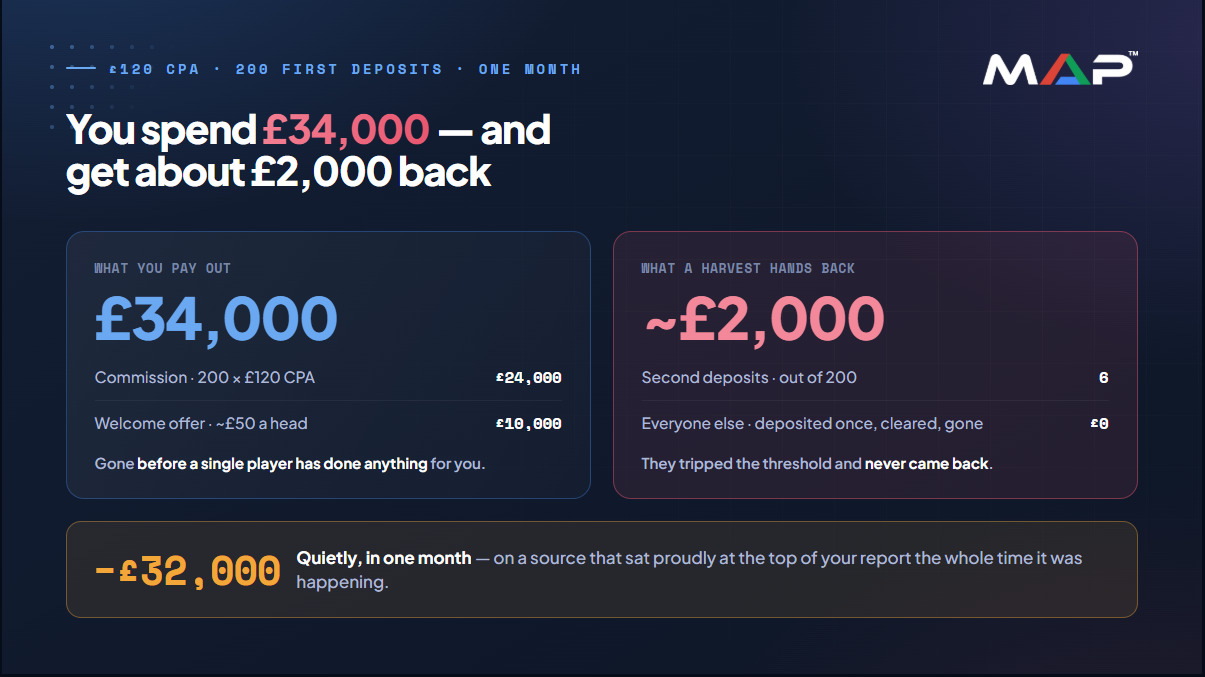
Say you pay £120 CPA, and you have got a source sending you 200 first deposits a month. Lovely. That is the sort of figure that gets an affiliate manager taken out to lunch. Your commission on it comes to £24,000. Your welcome offer costs you somewhere around £50 a head once you count what actually gets played through, so call that another £10,000, and you are now £34,000 into this one source before a single one of those players has done anything for you whatsoever.
On a clean source, a decent chunk of those people stick about. They deposit again, they play through the autumn, they have a few good weekends and a few rotten ones, and what they hand back over the next year covers what you paid to get them and then quietly keeps going. That is the whole point of buying traffic in the first place.
Now here is the awkward bit. On a harvested source, almost nobody comes back at all. They deposited exactly enough to trip your threshold and not one penny more, they took the welcome bonus, they cleared the wagering at the fastest speed the game would physically allow them, they pulled out whatever survived, and then they were gone. Out of your 200, perhaps six ever put their hand back in their pocket a second time. Six. So what those players hand you across their entire so-called lifetime comes to a couple of thousand at the very best, and you spent thirty four grand to buy it.
And that gap, that right there, is what fraud actually costs you. It is the very same gap we went into in our piece on FTD value against real lifetime value , only this time somebody is prising it open on purpose. Not some dramatic heist. Just thirty odd thousand quid, quietly, in one month, on a source that sat proudly at the top of your report the whole time it was happening. Somebody probably got a bonus for signing it.
Why On Earth Does It Always Look So Good#
Whenever we explain this to an operator the very next question is always the same, always, and it is a totally fair one. If the numbers looked that good, how on earth was anybody supposed to know?
And look, from where you were sitting, you genuinely could not have known, not from the dashboard you were staring at. But there is a real logic underneath this and it is worth understanding even if you do not much enjoy it, because understanding it is basically how you defend yourself.
A man optimising hard for the exact thing you reward is going to sit at the top of a report that only measures the thing you reward. That is not him being clever, and it is not you being thick either. It is just what happens when every metric on the dashboard measures the front of the funnel, because the front of the funnel is the only part he ever had to fake. The conversion rate is glorious because he is not converting anybody at all, he is manufacturing the event you pay for. The deposits land like clockwork because clockwork is precisely what a script does. And the whole lot sails through your monthly review untouched, month after month, because nothing in that review ever asks the one question that would give the game away, which is what happened to these players afterwards. If your reporting is all front of funnel and nothing else, our run through of the 14 KPIs every iGaming affiliate manager should track is worth half an hour of anybody's morning.
That is the honest reasoning, and it is not comfortable. The people doing this have got a lot cleverer over the last few years, and that is exactly where you need to keep your wits about you in 2026.
Where It All Quietly Goes Wrong For The Operator#
The idea itself is simple enough. The specific holes people climb through, though, are where the real damage hides, and here is the stuff you actually need to watch for.
First, a qualification event that costs nothing to fake. This is the big one, no two ways about it. A flat first deposit threshold is the softest possible target you could hand anybody, for one very simple reason, which is that it is trivially cheap to satisfy. Somebody stands up a small crowd of accounts, funds each one himself with just enough to trip the threshold, takes the welcome offer, and wanders off. On paper you have acquired twenty new depositors this month and everybody is thrilled. In reality you have bought twenty accounts that each cost you a commission plus a bonus, and there was never going to be a second deposit out of a single one of them. The lazier version of the very same trick is the affiliate who signs up under his own link, or ropes in three mates and a cousin to do it for him, and collects a commission on a player who was only ever going to be him. Which model you pay on matters a great deal here, and we pull that apart properly in CPA vs revenue share vs hybrid .
Second, and this is the sneaky one a lot of people miss, is your own tracking being turned against you. The oldest trick in that particular book is somebody quietly loading your cookie into browsers that never clicked on a single thing. That person wanders off none the wiser, and if they ever turn up at your casino weeks later under their own steam, through Google, through the app, because a mate mentioned you down the pub, your tracking looks down, sees that cookie sitting there patiently waiting, and hands over the credit and the money for a player he never sent you and never spoke to in his life. The nastier end of that same street is bot traffic and the deposits pushed through on stolen cards, and that one does not hit you once, it hits you three separate times, because you pay the commission, then the deposit gets charged back a few weeks later, and then your chargeback ratio with the payment provider takes a hit on top of all that.
Third, watch the players who were already yours. This is the category where reasonable people genuinely fall out with each other, and we do understand why. An affiliate buys paid search ads on your own brand name, plants himself right above your organic listing, and catches the player who was already halfway through typing your casino into Google with every intention in the world of coming straight to you. And then you go and pay a commission for that player. A player you already had. You are renting your own front door back off somebody else, and while you are at it you are bidding against your own affiliate on your own trademark and shoving your own paid costs up in the process. The same idea turns up as coupon toolbars firing a click at the very last second before a deposit that somebody else already earned, so the affiliate who wrote the honest review and built the site and did all the persuading gets nothing, and the plugin that showed up at the finish line takes the whole payment. That one poisons your relationships as well as your budget, because your good partners always notice, and they will not carry on losing their commissions to a toolbar out of loyalty to you.
Fourth, and this is the one that ought to worry you rather more than the money does, is traffic you are not allowed to have in the first place. An affiliate sends you players out of a geo you hold no licence in, routed through a proxy so it lands in your reports looking like a nice safe market you are perfectly happy with, or he runs a channel you expressly banned in your own terms and then simply declares it in the platform as SEO, because who is ever really going to check. And the regulator is not remotely interested in whose fault that was. In most serious markets the operator carries the can for whatever gets done in the operator's name, and it will not help you one bit to explain that you had no idea, because not knowing is very often the precise thing they will come after you for. That is not a lost commission. That is a licensing problem with your name on it and nobody else's.
The Honest Bit: Not Every Strange Number Is A Fraudster#
Now, before you go and cut off half your programme on a Monday morning in a fit of righteous fury, let me be fair to the other side of it for a second, because we would not be doing our job if we only scared you.
Affiliates are not all the same and their traffic does not all behave the same way, and a source that looks a bit odd is not automatically a source that is robbing you blind. A partner running a big seasonal campaign throws up a spike that looks alarming on a chart. A new affiliate finding his feet has a thin, strange looking first month. Some geos genuinely do deposit small and play slowly, and some perfectly honest sources have always converted better than the rest of your book, which is very often the exact reason you signed them in the first place. Go in swinging at every anomaly you see and you will burn good partners who did nothing wrong at all, they will take their traffic off to somebody friendlier, and word gets round the affiliate world faster than you would believe.
The operators who genuinely get burned by fraud are almost never the ones who investigated and got it a bit wrong. They are the ones who never looked at all, because the numbers were good and nobody much fancies poking at good numbers. Looking properly is ninety percent of defending yourself. The other ten percent is having the data to tell an honest anomaly apart from a dishonest one, and we will get to that in a minute.
How To Actually Handle It In 2026#
Right, enough theory, what do you actually do about this on a Monday morning. Here is the practical lot.
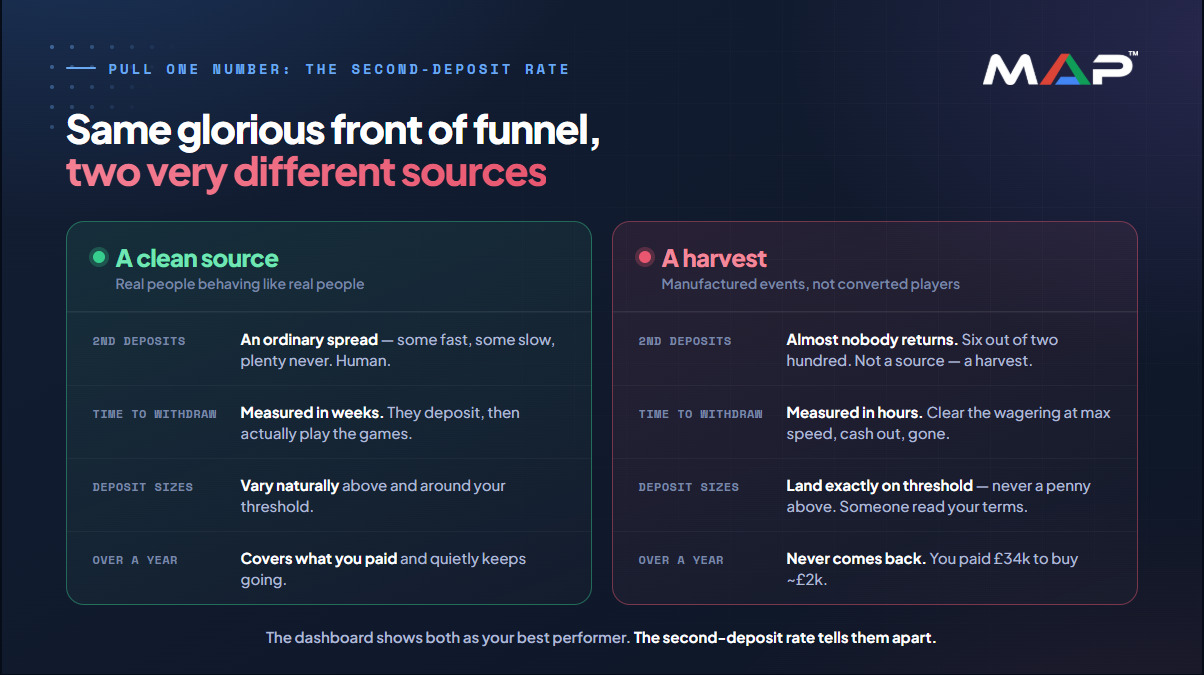
Go and pull your second deposit rate, cut by source, before you touch anything else. If you take one single thing away from this whole article, please make it that one. It is the most revealing number you own and it is the one almost nobody ever thinks to look at, because a clean source has a perfectly ordinary spread of people who come back and top up again, some quickly and some slowly and plenty never, the way actual human beings behave. A source where almost nobody ever puts their hand back in their pocket is not really a source at all. It is a harvest.
Then look at the gap between the money landing and the money leaving, because real players deposit and then, funnily enough, they go and play the games, whereas harvested ones clear the wagering at maximum speed and get out. When your average time to first withdrawal on one source is measured in hours while everybody else on the programme is measured in weeks, that is not a quirk and it is not some cultural difference in that market, whatever anybody tells you. And while you are in there, have a look at what the deposits actually are, because when a suspicious number of them land on exactly your threshold figure and never a penny above it, somebody has been reading your terms rather more carefully than you would like.
Fix the qualification event itself, and honestly this single lever does more work than everything else on this list put together. Tie your payment to something that costs a fraudster real money to fake, whether that is a wagering requirement, or a second deposit, or a simple check at day thirty to see whether the account is even still breathing. Every one of those makes the harvest less profitable, and the quietly lovely part of it is that not one of them costs your honest affiliates a thing, because their players were going to do all that anyway, weren't they. The only people who will scream about the change are precisely the people you were hoping to frighten off.
Get a holdback and a clawback into your terms, and write them properly rather than copying somebody else's out of some old contract. That means a payment window long enough for the chargebacks and the early withdrawals to actually surface before the commission goes out the door, and a clear written right to take the money back on players who later turn out to be fake. Be upfront about all of it during onboarding as well, because honest affiliates are perfectly fine with a clawback clause, they have got nothing to fear from it, and the ones who kick up an enormous fuss about it before they have sent you a single player are telling you something rather useful about themselves free of charge.
And if you run master and sub-affiliate structures , tighten the same rules a tier down, because an override paid on a harvested sub is still money walking out of your door. Write your brand bidding rules down in plain words, then actually go and monitor them, because a rule that nobody ever checks is not a rule at all. It is a wish.
So How Do You Actually See Any Of This#
And that, more or less, is the exact spot where most operators get properly stuck, because you cannot manage what you cannot see, and doing everything we have just described by hand, across forty partners and six markets, every single week, on a spreadsheet at midnight, is a full time job that nobody in your building actually has. Somebody does it beautifully for about a month and then quietly stops, and the fraudsters, who are very patient people, are counting on precisely that.
This is a big chunk of why we built MAP the way we built it over here at Mediacle. The platform runs on server to server postback tracking rather than leaning on browser cookies, and that is not a technical detail for the sake of it, it is this exact problem, because a postback fired server to server is a great deal harder to stuff or spoof than a cookie sat in a browser that anybody with a bit of time can go and poke at. The cross device attribution then closes the gap fraudsters love to hide inside, where a click on a mobile and a deposit on a desktop get treated as two unrelated strangers who happened to wander in on the same day. The full click-to-payout picture is walked through in our operator’s guide to affiliate tracking software, since anti fraud belongs at the tracking layer before it belongs anywhere else.
The machine learning fraud detection sitting on top of that is really just doing all the pattern work we walked through up there, across every source you have got, all day and every day, at a scale no human team is ever going to manage on their own. Deposit and withdrawal timing. Device clustering. Sources whose second deposit rate quietly fell off a cliff this month while everybody was busy admiring the front of the funnel. It flags the shape of the thing, and then a person goes and looks at it properly, which is also how you avoid cutting off a perfectly good partner over one odd week.
The granular commission engine matters here more than people expect, because once you can set qualification rules right down to the individual brand, geo, source and affiliate, you can hold a brand new untested partner on a stricter engagement based trigger while your trusted long standing ones carry on with their simpler terms. You stop having to run your whole programme at the speed of your least trustworthy partner, which is what an awful lot of operators are quietly doing without ever having sat down and decided to. And the audit trail covers the other half of it, so when something does go wrong, and occasionally it will, you can see precisely who changed what and when, which is exactly the question your regulator will put to you and not one you want to be answering with a shrug. It is a fair bit of why operators move to MAP in the first place.
If you are choosing a platform partly on how well it handles this stuff, and honestly you should be, our buyer's checklist for iGaming affiliate software walks through exactly what to look for so you do not end up on a system that keeps you in the dark about your own money.
Pulling It All Together#
Affiliate fraud is not some dramatic heist, even though it very much feels that way once you finally spot it and go back through the reports with your stomach sinking. Most of the time it is a slow, boring, unglamorous little leak that runs for months while everybody looks the other way. A source with a conversion rate nobody ever questioned, because it was making them all look rather good. A trigger that was far too easy to trip. A brand bidding rule written down once, years back, and never enforced by a living soul. Money going quietly out of the door, month after month, for players who were never really yours to buy.
Fix the qualification event, watch your second deposit rates by source rather than staring at the conversion rate and feeling pleased with life, keep a clawback in your terms so a fast payment is never a permanent one, and put a human being on the outliers before you cut anybody off, especially the ones who might just be having an unusual month. Do those few things and this stops being the thing that quietly eats your acquisition budget.
So go and pull the second deposit rate on every source you have got, and do it this week rather than next quarter, and have a proper look at how fast the money comes back out again once it has landed. Then ask yourself honestly whether your top converting partner is genuinely your top converting partner, or whether he is simply the one standing closest to the till. And if you want to see what all of that looks like laid out in the open in real time instead of buried in a spreadsheet you never quite have time to build, book yourself a demo of MAP and we will happily walk you through the whole thing. Simple as that, really.