Pretty much every other week somebody drops us a line over here at MAP asking more or less the same thing, and it usually arrives sounding a little bit panicked, a little bit cross, and it goes something like this. "I sent good traffic all month, my players were active, my report says the operator owes me nothing, and next month I am apparently starting from behind. How is that even legal?" And honestly, fair enough, because the first time negative carryover reaches out and bites you, it feels less like a contract clause and more like somebody has quietly reached into your account and helped their own self to a couple of your months.
So let us actually sit down and go through it properly, the way it genuinely works rather than the way the account manager waved it off when you signed, because this one little clause tucked away in the rev share section of your deal is the single thing that decides whether your rev share book feels like a slow steady income or a slot machine that keeps swallowing your coins and giving nothing back. It is worth understanding. Truly it is. Right then, here we go.
Quick word before we dive in properly. Market sizing in this corner of the world is messy, truly, truly messy, and different research houses count things in their own funny way, so wherever the numbers disagree, we have just handed you the range instead of pretending there is one true holy figure carved in stone somewhere. That is simply how it goes. Right then, let us get into it.
So What Even Is Negative Carryover#
Right, the plain version first, no jargon, no clever stuff.
When you are on a revenue share deal, you get paid a percentage of the net gaming revenue your players hand the operator. Net revenue, just so we are all on the same page here, is what is left over after the operator has taken out bonuses, payment fees, jackpot contributions, the platform provider’s cut, and a whole quiet little list of other bits and bobs off the top before anybody calls the leftover "revenue." You already know all that if you have read our piece on CPA vs revenue share vs hybrid, and if you have not then go and read it, because it sets up this whole conversation. The order those deductions come off in matters more than most people think, and how NGR is calculated for rev share walks through it one line at a time.
Now here is the awkward bit. Some months, your players win. Not you, them, the actual punters. They have a lucky run on the slots, or a couple of them land a decent sportsbook accumulator on the same weekend, and when the dust settles the operator has paid out more to your players than those players put in. That month, the net revenue on your book is not just low. It is a negative number. The operator lost money on your traffic that month, fair is fair, that does genuinely happen.
Negative carryover is the clause that says that the minus number does not just vanish into thin air at the end of the month. It carries over. It rolls forward into next month and sits there against your account like a little debt, and before you earn a single penny in the new month, your fresh revenue has to first climb back up out of that hole and get you back to zero. Only after you have clawed your way back to break even does the operator actually start paying you your share again.
So that "you owe nothing this period" email is not the operator robbing you exactly. It is the deal you signed, doing precisely what it always said it would do in clause whatever point whatever. It just never really feels that way at the time.
A Quick Little Example So It Actually Lands#
Numbers make this click, so let us do numbers, and I will keep them nice and round.
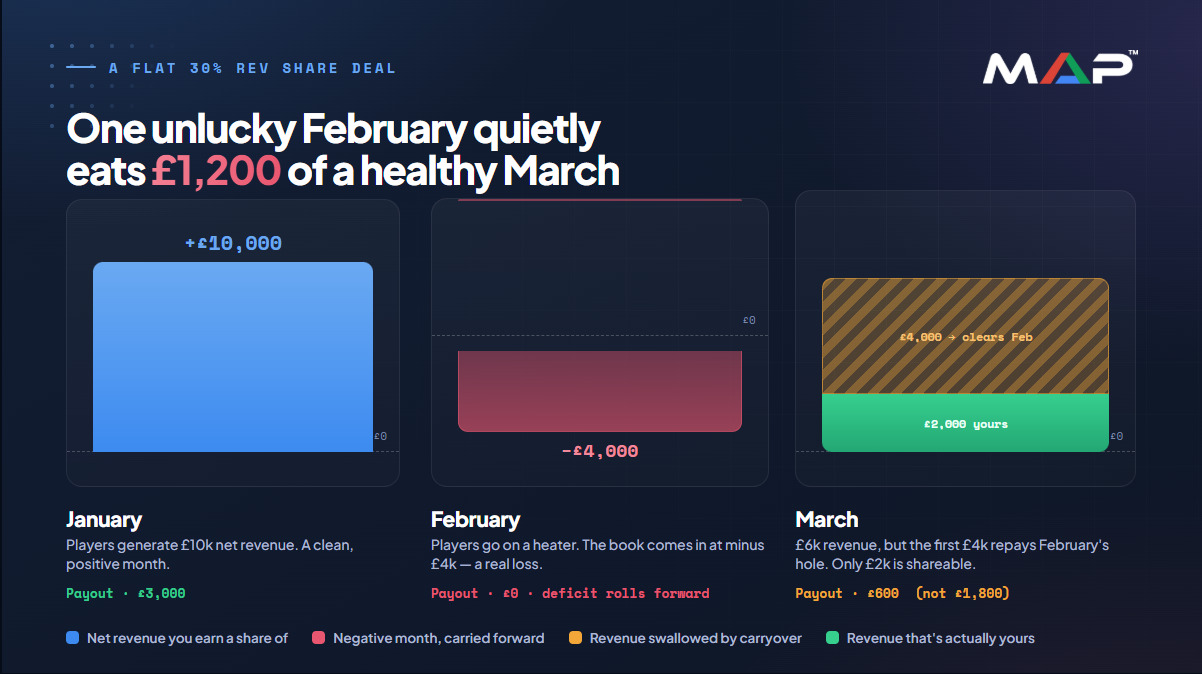
Say you are on a flat 30% rev share. In January, your players generate £10,000 of net revenue for the operator. Lovely. Your cut is £3,000; it lands in your account, everyone is happy and nobody emails anybody.
Now February comes along and February is rough. A handful of your players go on a heater, they win big, and instead of generating positive revenue, your book comes in at minus £4,000. The operator paid out four grand more than your players deposited and lost. Your rev share on a negative number is nothing, obviously, you do not pay the operator, so February you earn £0. That part most people expect.
Here is where the carryover actually shows its teeth. That minus £4,000 does not reset when the calendar flips. It rolls into March. So in March your players generate a healthy £6,000 of net revenue, and you are sitting there rubbing your hands, expecting your 30%, which would be £1,800. Except the first £4,000 of that March revenue goes toward paying off February’s hole. Only the £2,000 left on top of that is yours to take a share of. So your actual March payout is 30% of two grand, which is £600, not the £1,800 you thought you had earned.
One healthy March, and because of one unlucky February hanging over it, you walked away with £600 where without that clause you would have taken the full £1,800. Twelve hundred quid of perfectly good March revenue, gone on paying off a month that was already over. That gap, that right there, is negative carryover, and now you can see exactly why it stings the way it does.
Why On Earth Do Operators Even Do This#
Whenever we explain this to a newer affiliate, the very next question is always the same, always, and it is a totally fair one. Why should the operator get to push their losing months onto me when they happily keep all the upside on the winning ones? Feels a bit one sided, does it not.
And look, from where you are sitting it genuinely does feel one sided. But there is a real logic underneath it, and it is worth understanding even if you still do not love it, because understanding it is how you negotiate against it.
The operator’s argument runs like this. Revenue share is meant to be a genuine partnership over the lifetime of a player, not a one month snapshot. If they paid you your full cut every winning month but ate the full loss on every losing month all by their own selves, then you would basicly be getting all of the good variance and none of the bad, and the operator would be carrying one hundred percent of the downside risk while sharing the upside with you. Over a big enough book, with players winning and losing month to month the way players always do, that lopsided setup would quietly bleed the operator dry. Negative carryover is how they make sure that across the whole lifetime of the relationship, you are sharing in the real economics of your traffic, the rough with the smooth, and not just cherry picking the sunny months.
That is the honest reasoning, and it is not nothing. The trouble is that operators have got a lot cleverer about how far they stretch this idea, and that is exactly where you need to keep your wits about you in 2026.
Where It All Quietly Goes Wrong For The Affiliate#
The concept its self is defensible. The way it gets written into some contracts, though, is where the real damage hides, and here is the stuff you actually need to watch for.
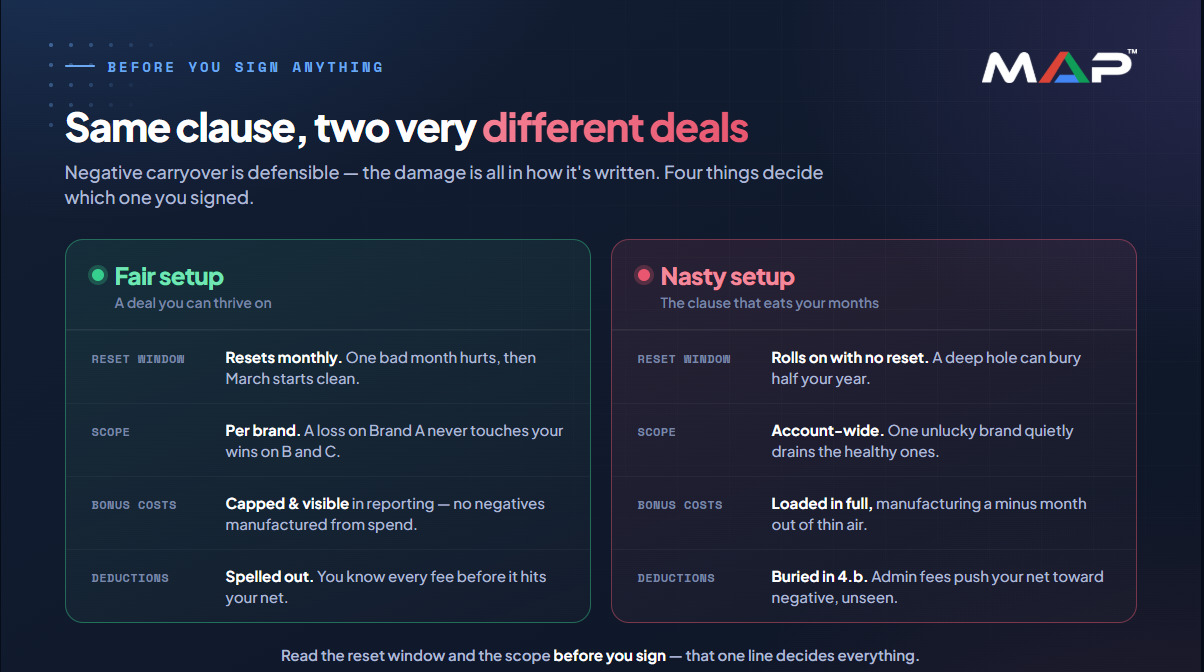
First, the reset window. This is the big one, no two ways about it. Does your negative balance reset to zero at the end of every month, or does it roll on and on and on untill you have earned it all back no matter how long that takes? A monthly reset is your friend, becuase it means one bad February is contained, it hurts and then it is over and March starts you clean. A rolling deficit with no reset is a very different animal, becuase a couple of bad months back to back can stack a hole so deep that you spend the back half of the year climbing out of it while sending perfectly good traffic the whole time and seeing nothing for it. Always, always find out which one you are signing.
Second, and this is the sneaky one a lot of people miss, is whether the carryover is calculated per brand or across your whole account. Say you promote three brands under one operator. Under a fair setup, a losing month on Brand A only offsets future earnings on Brand A. Under a nastier setup, a loss on Brand A gets dragged across and wiped off against your winnings on Brands B and C, so one unlucky corner of your book quietly drains the healthy bits too. Cross brand carryover can turn one small problem into a whole account problem before you have even noticed.
Third, watch how bonus costs feed into the negative in the first place. If the operator is running aggressive welcome offers to your players and then charging the full cost of those bonuses against your net revenue, they can manufacture a negative month almost out of thin air, specially early in a player’s life when the bonus spend is heaviest. You want some kind of sensible cap on how much bonus cost can be loaded onto your book, or at the very least you want to see it clearly in the reporting so you are not left guessing where the hole came from.
Fourth, the admin fees and the minor deductions. Some contracts let the operator pile processing fees and various little "operational costs" into the calculation, and every one of those pushes your net down closer to negative and makes carryover more likely to kick in. It is all in the fine print. Read clause 4.b like it is going to test you on Monday morning, because in a very real way it actually is.
The Honest Bit: It Is Not Always The Villain#
Now, before you swear off rev share forever and run screaming back to pure CPA, let me be fair to the other side of it for a second, because we would not be doing our job if we only scared you.
Negative carryover on a fair, monthly reset, per brand basis is honestly a reasonable part of a grown up rev share relationship. It is the price of admission for getting a proper share of the long term upside, and that upside, when it compounds, is the whole reason rev share can turn into something close to passive income after eighteen or twenty four months of steady traffic. If you want the fat sticky lifetime revenue, you have to accept that lifetime revenue includes the odd month where the house loses. You cannot really have the one without the other. That is just the maths of variance doing its thing.
The affiliates who genuinely get burned by carryover are almost never the ones who understood it and priced it in. They are the ones who never read the clause, never asked about the reset window, and then got blindsided in month three wondering where their money went. Understanding the thing is ninety percent of defending against it. The other ten percent is having the data to argue your corner, and we will get to that in a minute.
How To Actually Handle It In 2026#
Right, enough theory, what do you actually do about this on a Monday morning when there is a deal sheet sat in front of you. Here is the practical lot.
Fight for a monthly reset before you sign anything, full stop. If the operator wants quarterly or, heaven help you, a rolling deficit with no reset at all, that is a genuine red flag and you should push back hard, or price the extra risk into a higher percentage to make up for it. Do not just accept the reset window they hand you because they smiled at you across the negotiation table.
Ask straight out whether carryover is per brand or account wide, and get the answer in writing, not in a friendly verbal "oh don’t worry about that." If it is account wide across multiple brands, you want to know that going in, because it changes how much risk you are really carrying.
page
If your traffic is the kind that runs high variance, and you honestly know your own book better than anybody, then carryover is going to hit you harder and more often than it hits a nice steady low variance affiliate. In that case, a hybrid deal is genuinely your best friend here, because the CPA slice keeps your lights on and pays your bills during the months the rev share tail is stuck clawing back out of a hole. We go deep on this in the CPA vs revenue share vs hybrid guide, and negative carryover is honestly one of the strongest arguments there is for going hybrid rather than pure rev share.
And here is the one that most people skip. Watch your negative carryover against your actual player lifetime value, not just month to month. This is where it ties straight back into the FTD value vs LTV conversation, because a month that looks negative on paper might be sitting on top of a cohort of players who are going to be worth a fortune over the next year. If you are only ever looking at the raw monthly minus number and panicking, you are missing the real picture. A player who wins big in February is very often a player who is engaged and having fun and is going to keep depositing right through to autumn. The negative month and the golden LTV can be the very same players. You have to be able to see both at once or you will make bad decisions off half the story.
So How Do You Actually See Any Of This#
And that, more or less, is the exact spot where most affiliates and honestly a fair few operators get properly stuck, because you cannot manage what you cannot see, and negative carryover is one of those things that is genuinely painful to track by hand across multiple brands and geos and months on a spreadsheet at midnight.
This is a big chunk of why we built MAP the way we built it over here at Mediacle. Inside the platform your carryover is not some mystery number that shows up in an email at the start of the month with no explanation attached to it. You can see exactly how a negative balance formed, which players and which bonus costs drove it, whether it is resetting the way your contract says it should, and how it is being applied against your fresh revenue, all in real time rather than a month and a half after the fact when it is far too late to do anything useful about it.
The granular commission engine lets operators set carryover rules cleanly per brand, per geo, per affiliate, so nobody is arguing after the event about whether a loss should have crossed from one brand onto another. The audit trail means both sides can look at the exact same numbers and actually trust them, which cuts out a genuinely enormous amount of the "your report says one thing and mine says another" back and forth that sours so many affiliate relationships. And because MAP puts your FTD value and your real cohort LTV right next to your monthly revenue, you can finally tell the difference between a negative month that is a temporary bit of variance sitting on top of brilliant players, and a negative month that is a warning sign your traffic quality has actually slipped. Those two things look identical on a raw monthly figure. They are completely different problems. Being able to tell them apart is worth a lot.
If you are choosing a platform partly on how well it handles this stuff, and honestly you should be, our buyer’s checklist for iGaming affiliate software walks through exactly what to look for so you do not end up on a system that keeps you in the dark about your own money. And if it is a casino programme specifically you are setting up, our operator’s overview of casino affiliate software covers the tracking, commissions, reporting and pricing decisions in one place.
Pulling It All Together#
Negative carryover is not some dirty trick the operators cooked up to fleece you, even though it very much feels that way the first time it lands on you out of nowhere. It is the mechanism that makes revenue share an honest long term partnership instead of a game where you scoop all the good months and leave somebody else holding all the bad ones. Understood and negotiated properly, with a monthly reset and per brand calculation and a sensible handle on bonus costs, it is a perfectly reasonable part of a deal you can genuinely thrive on.
Where it turns nasty is in the fine print you did not read, the rolling deficits, the cross brand offsets, the manufactured negatives from aggressive bonus spend, and the plain simple fact that most affiliates cannot actually see their carryover clearly enough to argue about it in real time. Fix that visibility, fight for the fair reset terms, watch your negatives against your real player LTV rather than panicking at a raw monthly minus, and lean on hybrid when your traffic runs the kind of variance that makes carryover bite hard. Do those few things and this clause stops being the thing that quietly eats your months.
So go and pull your rev share reports, find the carryover line, actually read how it is being applied, and if you cannot see it clearly then that is honestly the first thing worth fixing before you sign anything else this quarter. And if you want to see what carryover looks like when it is laid out in the open next to your real player economics instead of hidden in a monthly email, book your own self a demo of MAP and we will happily walk you through the whole thing. Simple as that, really.
Frequently asked questions#
Sometimes, yes, specially if you are a big affiliate sending serious volume and you have got a bit of weight to throw about in the room. But be a bit careful what you wish for, because an operator who agrees to strip out carryover entirely will very often quietly claw that risk back somewhere else, usually by offering you a lower base percentage or shorter lifetime terms. There is no free lunch in these deals, there never is. Fair is fair, if you take the downside risk off their plate they are going to want something back for it.
In a way, yes, and it comes back to player lifetimes shrinking. With the average casino player in a lot of mature markets now active something like four to six months instead of the old eighteen, and with regulation tightening deposits and bonuses across the UK and the Netherlands and Germany and bits of Australia, revenue is choppier and thinner than it was, which means negative months turn up a little more often and are a little harder to climb back out of. The clause has not changed. The conditions it operates in have got tougher, so it matters more than it did even two or three short years back.
Not necessarily, but it is a genuinely good reason to think hard about hybrid. Pure CPA sidesteps carryover completely because you get paid once and walk away, but you also hand the operator all of your long term upside when you do that. Hybrid lets you keep a slice of the lifetime value while the upfront CPA cushions you against the months carryover would otherwise leave you on zero. For a lot of mid sized affiliates in 2026 that middle path is quietly become the sensible default, and carryover is a big part of the reason why.