Pretty much every single week, somebody out there drops us a line, asking more or less the very same thing, just worded a tiny bit differently each time around. They are about to go pick a new affiliate platform, or maybe swap off the one they have quietly outgrown by now, and they really want to know what genuinely matters over here and what is, to be honest with you, just noise printed up on some glossy feature sheet. Fair question that one, truly it is. We have onboarded a lot of operators down the years over here at Mediacle. MAP runs the affiliate side of the house for 250+ iGaming brands now, and we have watched folks pick brilliantly and we have also watched folks pick in a way they ended up regretting alot about eighteen months down the line. So we figured we would just sit ourselves down and write the whole thing out, properly.
This is not a sales pitch, or well, we have tried our level best to keep it from turning into one anyway. Think of it more like the honest little checklist we would hand over to a mate who runs a casino brand and asked us over a coffee which software he should be going with. We grouped it all up by the stuff that actually moves the needle, threw in the common mistakes we keep seeing again and again and again, and kept the whole thing nice and plain. Right then, let us get into it shall we.
If your mate happens to run a casino specifically, our operator’s guide to casino affiliate software is the shorter companion to this piece, cutting straight to how the tracking, commissions and pricing all fit together on the ground.
1. Start with how your program actually runs, not the feature list#
Here is the mistake we watch nearly everybody out there go and make, and it is such an easy little trap to fall into. They open up six vendor tabs, line up all the feature tables side by side by side, and start counting the little green ticks like it is some sort of a scoreboard. More ticks wins, supposedly. Except it really does not work like that at all, not one bit. A platform that is stuffed full with two hundred features you will never once go and touch is not even a little bit better than a lean one which absolutely nails the ten jobs you actually do each and every single day. Feature counts are vanity, truly they are.
So before you go off and book your own self a single demo, just sit down and scribble out how your program really runs in the real world. Are you on CPA, or RevShare, or some hybrid blend of the two of them? How many brands are sitting under your operating company? Which markets, which currencies, how many affiliates have you got today and roughly how many do you reckon you will have in two years if it all goes to plan? Get it down on paper, each bit of it. That scrappy little doc quietly becomes your scorecard, and honestly it makes the whole entire hunt about ten times quicker. If you fancy a proper breakdown of the commission side before you go deciding anything, we went really deep on CPA vs RevShare vs hybrid in a seperate piece over here.
2. Tracking, because everything else hangs off it#
We cannot really say this one loud enough, we honestly cannot. Everything in this whole game, it begins and it ends with the tracking. If those numbers happen to be even a tiny bit off, then nothing else on the platform holds any meaning at all, none of it, because you will be sat there paying your partners on dodgy data, arguing over discrepancies in your inbox untill you are blue in the face, and slowly chipping away at the trust of the exact same affiliates you bent over backwards to go and sign in the first place. That is the fastest way there is to wreck a young program, no two ways about it.
So get right under the hood and go ask the slightly awkward questions, one and all. Is the platform leaning only on cookies, which, let us be honest with our own selves over here, are dying a slow and a very public sort of death? Or does it do proper server to server postbacks with clean click ID passing? What happens with a player who taps an affiliate link on thier phone while sat on the train, then goes and deposits from a laptop three days later, does the software still join those two events up togather into the one? Ask them to walk you through the attribution in plain words, not buzzwords. If they go all vague and hand wavy on you right there and then, well, that tells you alot.
And here is the bit that so many operators just skip, then quietly go and regret. Test the tracking your own self during the trial, with real traffic, on real devices, with your own two eyes. A polished demo running away on the vendor's own laptop proves basically nothing at all. You want to watch one single click turn its self into a registration and then into a deposit, live, right there in the dashboard, before you go trusting a word of it. Specially that deposit event, since that is definately the one your commissions actually hang off in the end of it.
If you want the whole tracking layer walked through end to end, from the Saturday night click through to the payout on the first of the month, our operator’s guide to affiliate tracking software covers each stop in turn.
3. Commission flexibility, because real deals are never tidy#
No two affiliate deals ever look quite the same out there, and your software it has got to roll with all of that mess. Some partners just want flat CPA and a nice easy life. Others want RevShare on the net gaming revenue. Then your big strategic ones, they come knocking wanting a custom hybrid, a CPA upfront, a smaller share on the back end, oh and a tiered bump the very second they cross some volume number you shook hands on months and months ago. Can the platform go and model all of that without you filing a developer ticket each and every single time? Because doing that lot by hand, it gets old really fast.
Have a proper good look at how granular the commission engine actually goes. Right down to the brand. The country. The traffic source. The individual affiliate even, if that is the way you want it. The good ones out there let you weigh FTD value against lifetime value so you stop overpaying for players who deposit the once and then go vanishing clean into thin air. That single capability, it holds the potential to protect your margins way more than any pretty dashboard chart ever possibly will, and it is exactly the sort of thing that does not go jumping out at you on a feature sheet.
4. Reporting and the numbers you live in#
You are going to be sat staring at this reporting suite each and every single morning with your coffee, so it had honestly better not wind you up. Real time matters way more than people expect it to going in. Finding out only tomorrow that today's campaign quietly fell flat over is exactly how budgets go getting torched, and nobody on this earth enjoys sitting in that meeting. Can you cut the data the way your own brain actually works, by affiliate, by brand, by whatever geo is keeping you up at night this particular week, by date range, and then can you export it cleanly when finance comes knocking on the door?
It also pays to know what reports come avaialble straight out the box rather than what you have to go building your own self. Not totally sure what you should even be measuring just yet? We keep a running list of the 14 KPIs every iGaming affiliate manager should track, and honestly most teams get a bit of a shock when they read it, at just how many of them they have been flying totally blind on this whole entire time. Hold any platform you are trialing up against that list and just see how much of it you can pull without raising a single support ticket.
5. Integrations, the bit that quietly makes or breaks the whole thing#

This right here is where alot of shiny platforms come apart at the seams, quietly, usually somewhere around month two of it. Your affiliate software, it does not live on its own little island out there. It has got to talk to your casino platform, and your CRM, and the payments side, and your BI stack, and the data warehouse, all of it, and ideally without making a great big song and dance about the whole thing. When it cannot, you end up with some poor soul on the team copy pasting spreadsheets togather at six on the last evening of the month. And they will not thank you for it, not one bit.
So ask for a straight and honest list of native integrations, and a real documented API sat on the top of it. Two way postbacks. Webhooks. The ability to push your raw data out to wherever your analytics people want it living over there. A vendor that tucks the API away behind a sales call, or wants a small fortune off you for one basic connection, is quietly showing you how the whole relationship is going to feel for the next few years. Believe them the first time, truly. For what it is worth to you, we never charge a penny for building a new integration during onboarding, we just go and build the thing, but you really should be checking this point with every single vendor you talk to.
6. Compliance, security and the fraud you cannot ignore#
iGaming is about as heavily regulated as industries come out there, so the tooling, it has to respect that right from the ground up, not as some bolt on you go paying extra for later down the line. Do not skim this part, we genuinely do mean it. Start with the data protection, player and affiliate data needs handling the proper GDPR way, with sensible role based access so not every junior on the team can go seeing absolutely everything in the building.
Then there is the fraud, and trust us on this one and all, fraud in this space is real and it gets expensive in a real hurry. Fake signups. Bonus abuse. Incentivised junk traffic dressed right up to look all lovely and organic. You want fraud detection baked properly in, specially the machine learning sort that goes flagging the weird patterns before they drain your budget rather than after the money has already walked its own self out the door. Ask them flat out how it works, what signals it watches, and whether you get to layer your own rules on top of thiers. And do not go forgetting the audit trails either, the day a regulator or a partner asks who changed which commission and when, you will be wanting a clean answer in about ten seconds flat, not a frantic scroll back through six months of old email.
7. Scalability, and all the boring stuff that saves you later#
It is so very tempting to just go buying for where you are sat right now. Far smarter though, to buy for where you are actually trying to get your own self to. If you are thinking about adding brands, opening up new markets, or growing your affiliate base ten times over, the platform it has got to stretch right along with you, without toppling over or dragging you through a brutal migration eighteen months down the road. Migrations are genuinely painful things, the historical data does not always come across all clean, and you tend to lose a couple of good affiliate relationships somewhere in the shuffle of it.
So check the dull stuff, because it is always the dull boring stuff that goes biting you in the end. Multi currency and multi language support, you will be needing both of them sooner than you reckon. Uptime and the infrastructure sat underneath it, since downtime in the middle of a big promo is the kind of nightmare you do not forget in a hurry. White label, if you want the partner portal wearing your own brand instead of somebody else's. Native mobile apps too, because affiliates basically live on thier phones these days, fair is fair. None of it is exciting. All of it hurts later on if it is not there.
8. Support, the human bit nobody puts on the feature sheet#
We could not write an honest checklist and quietly go leaving this one off the list. When something breaks at nine o'clock on a Friday night, right before a big weekend promo goes live, having a real account manager who actually picks up the phone is the whole entire difference between a minor little wobble and a proper full blown crisis. You do not want to be bounced around between five different departments just to get one postback URL fixed. So ask how the support genuinely works, who you end up actually talking to, and whether you can reach a real engineer when something properly complicated crops up. It is honestly one of the quieter reasons operators move over to MAP and then stick around for years, and funnily enough it never once shows up on a comparison grid.
9. Pricing, and what it really costs you over time#
Price obviously matters, of course it does, but the headline number sat on the brochure rarely tells you the real story of it. Some vendors out there reel you in with a tiny monthly fee and then go nickel and diming you for every integration, every extra brand, basically every time you so much as breathe near thier support desk. Others just bundle the whole lot in, which is honestly how we reckon it really should work, but very few of them actually go and do it. Ask in plain words what is included, what quietly counts as a paid add on, and whether the upgrades are going to cost you more money down the line.
And think across two or three years, not just month one. Something a bit pricier that goes saving your team hours every single week and protects your margins through smarter tracking can easily work out way cheaper in the long run of it. Cheap software that you are forever working around by hand was never actually cheap, not really, you just ended up paying for it in a different sort of currency. More operators run thier own program for exactly this reason these days rather than renting out space on somebody else's network, and we wrote up why you should have your own affiliate programme if you fancy the longer version of that whole argument.
10. The mistakes operators make, so you can skip them#
Since we have watched this play its own self out a good few hundred times now, here are the three regrets that come up the very most, by a mile.
The first one, and it is not even close honestly, is picking the cheapest option at launch and then having to migrate over to something more capable two years in, after the program quietly outgrew it. We said it further up but it is worth saying it twice, migrations hurt, so pick something that scales even if the launch cost stings you a little more today.
And the third one, a bit niche this one, is picking a platform purely because it turns up with a big affiliate network attached to it, when really the features and the support are what will define how your program runs for the next five years. The network is a nice to have, not the main event at all.
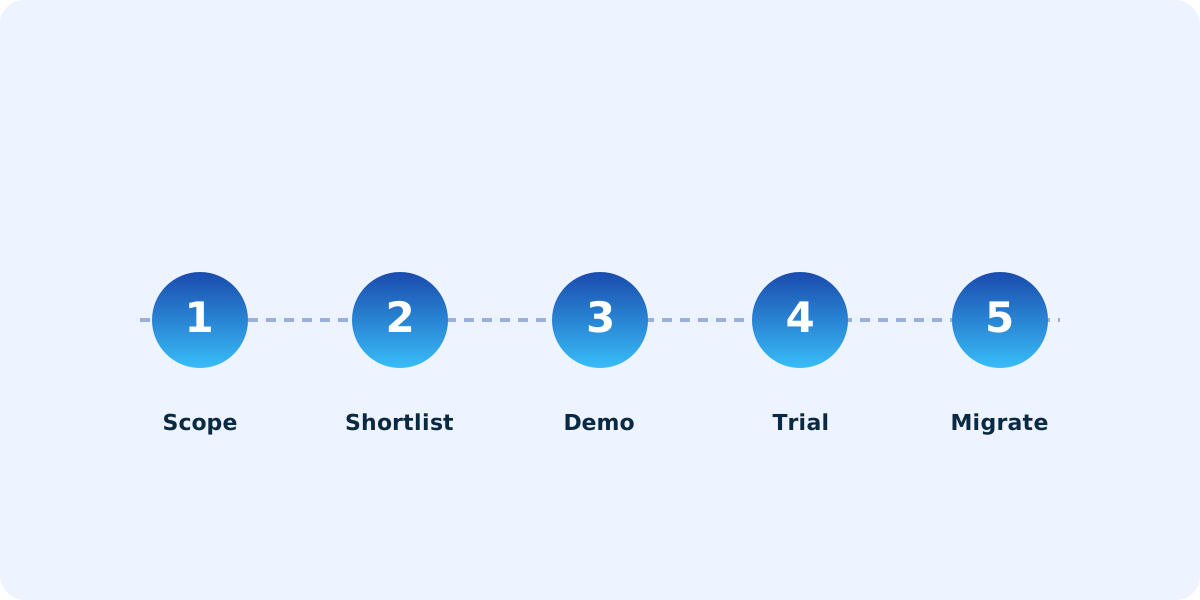
Your quick buyer's checklist
Here is the short version to keep open in a tab while you go comparing vendors. Run every single option past these and the right pick, it usually starts making its own self pretty obvious.
- Does the tracking do proper server-to-server postbacks and cross-device attribution, and did you actually go and test it with live traffic?
- Can the commission engine cope with CPA, RevShare and messy custom hybrids, right down to brand, geo and the individual affiliate?
- Is the reporting real time, and can you slice and export it the way your own head works?
- Is there a documented API and proper native integrations into your casino platform, CRM, payments and BI tools?
- Is player and affiliate data handled the GDPR way, with sensible role-based access?
- Is there built in, machine learning fraud detection, plus a full audit trail you can actually pull from?
- Will it stretch across more brands, markets, currencies and languages without a painful migration later on?
- Do you get a real account manager, and support that genuinely picks up when it all goes sideways?
- Is the pricing transparent, and does the two to three year total honestly add up?
Pulling it all together#
Choosing iGaming affiliate software is really a long term partnership wearing its own self a software purchase costume. Get the tracking, the flexibility, the integrations, the compliance and the room to grow all pointing the right way, and the platform sort of fades off into the background and just lets you crack on with running the business. Get it wrong though, and you will feel that friction every single day, no exaggeration at all. MAP is built around exactly these priorities, and it is trusted by 250+ brands across more than twenty countries, US licensed operators included. If you fancy seeing how it holds up against your own checklist, go and have a proper poke around the full feature set, or just book a demo with the team and run it on your own traffic for a little bit. That is honestly the only way you will ever really know for sure.
Frequently asked questions#
Depends massively on how many brands and integrations you are dragging across, but a decent vendor hands you over a realistic timeline and an actual migration plan, not just a shrug and a confident little smile. Most setups land somewhere between two and six weeks, with the average operator going live in around three of them. If they cannot roughly walk you through how the onboarding works, be a little bit wary.
You can, and a handful of the really big operators out there do, but it is a serious and frankly never ending engineering commitment. You would be babysitting tracking, fraud, payments and compliance reporting forever, all on your own dime, and for most brands that ship has well and truly sailed once they do the maths on it properly. Buying frees your people up to actually go and grow the program, which was the whole entire point of the exercise.
Usually yes, as long as the new platform takes the migration seriously. Ask upfront exactly how they bring across your affiliates, your existing deals and your past numbers, and whether they run a parallel test against the old system before cutting fully over. Honestly, the way somebody answers that one single question tells you alot about how the next few years are going to feel.
Going for the lowest cost option at launch and then having to rip it back out and migrate two years later when the program outgrows it. It is such a common one, we see it all the time. Pick for where you are heading, not just for where you are stood today, and you will save your own self a whole world of pain later.