Every single operator we have ever moved across to MAP has asked us more or less the same question somewhere inside the first fifteen minutes of the very first call, and it is almost never about the pricing, and it is almost never about the features either. It is this one. What happens to our history. Four or five years of revenue sat in the old platform, affiliate deals that got agreed over email back in 2022 and never really written down anywhere sensible since, tracking links scattered across a couple of hundred partner sites that nobody at the company has bothered looking at since the day they first went live, and a payments record that the finance team quietly leans on at the end of every single month without ever thinking about it. Nobody in the building wants to be the person who signed off on loosing that lot.
And it is a completely fair worry to be carrying about with you, truly it is. We have sat through enough of these moves over here at Mediacle, with MAP now running the affiliate side of the house for 300+ iGaming brands, to know that the fear is aimed at roughly the right thing even when it is aimed at entirely the wrong part of it. Becuase the history does not go and vanish. Not really, no. What actually happens when one of these moves goes badly is a good deal duller and a good deal more expensive than some big dramatic loss of data, and it tends to sit there unnoticed for weeks on end before anybody cottons on.
So let us pull the whole thing apart slowly, the way you would want it laid out if you were sat there with a signed contract in one hand and a fairly nervous head of finance in the other.
The Bit Where Somebody Finds Out By Accident#
There was an affiliate manager we worked with a while back, and we will call her Katya, and we have blurred a few of the details on purpose here becuase it is not really our story to go telling. Mid-sized casino group, three brands, a programme that had been quietly ticking along on the same platform since somewhere around 2019.
She was not even doing migration work when she found it. She was doing something totally unrelated on a Tuesday afternoon, pulling a list of active affiliate accounts becuase somebody upstairs wanted a headcount for a budget meeting, and while she had the export open she got curious and went and looked at where the clicks were actually arriving from. And there it was. A redirect domain, set up years and years back by an agency that had long since stopped working with them, still resolving perfectly happily, still passing traffic through to the brand, and still carrying somewhere north of a tenth of the programme's monthly clicks. Nobody in the company owned it. Nobody was paying for it either, as far as anybody could tell, untill they eventually worked out the renewal was sat on somebody's old personal card.
Now here is the part that matters for you. If that migration had gone ahead on the timeline they originally had in mind, that domain would have kept on pointing at a platform they had already switched off, and about thirty affiliates would have carried on sending real players down a dead pipe for however long it took somebody to notice. Which, going by the way these things usually go, would have been the first angry email of the next payment cycle.
Katya did not find that by being clever. She found it because she happened to open the wrong report on a slow afternoon. That is the honest shape of nearly every migration problem we have ever watched happen.
What People Actually Mean When They Say They Will Lose Thier History#
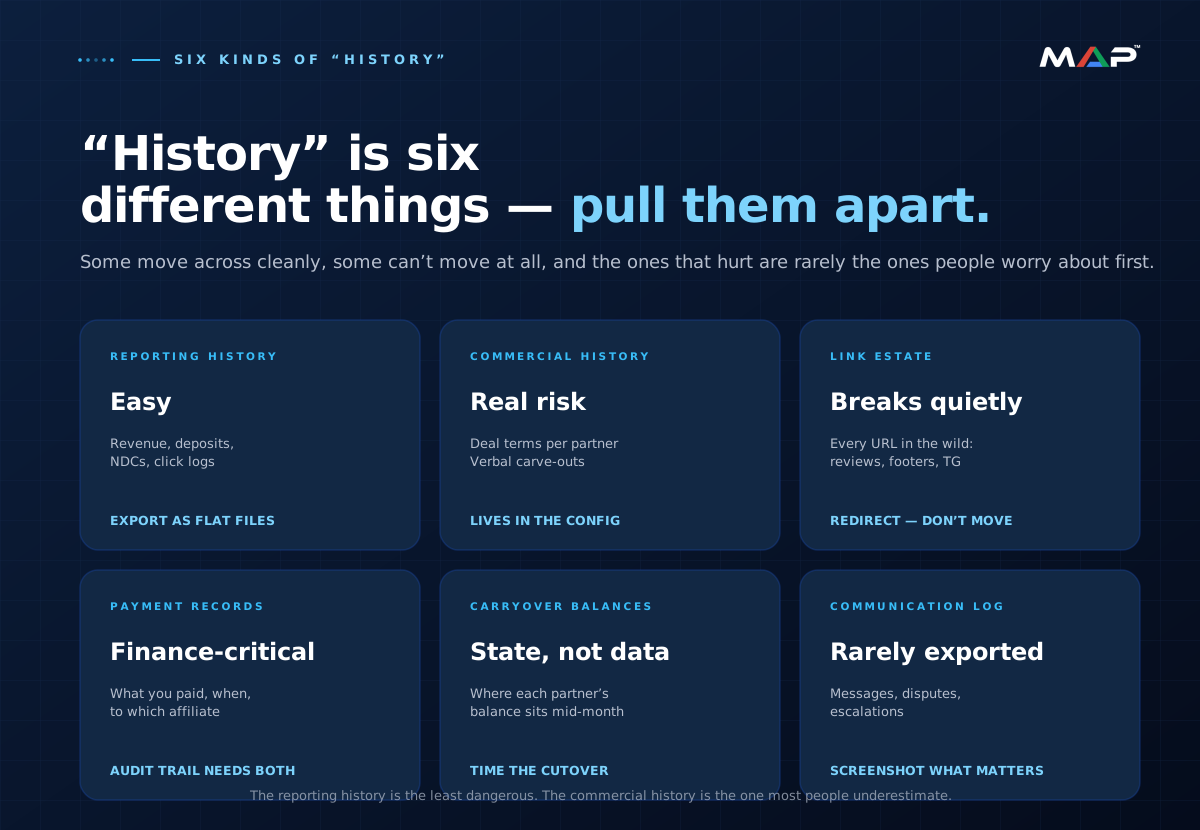
When an operator says history, they are usually saying five or six different things all at once and not seperating them out, which is exactly why the whole conversation gets so tangled up so quickly. It is worth pulling them apart, becuase some of them move across easily, some of them cannot move at all, and the ones that hurt are almost never the ones people are worried about on the first call.
The reporting history is the one everybody names first, meaning your revenue and your deposits and your NDCs and the click logs going back however far the old platform bothered keeping them, and honestly it is the least dangerous item on the whole list, because it is just data sat in a database and data sat in a database can be exported into flat files and those files can be kept for as long as your retention policy says they have to be kept.
Underneath that sits the commercial history, which is a very different animal, becuase it is the actual deal terms every single affiliate account is sat on right now. Somebody is on 35% rev share with a monthly reset. Somebody else got handed a hybrid back in 2023 that nobody currently in the team can properly explain, and two of your bigger partners have gone and got themselves geo-specific carve-outs that were agreed verbally at a conference in Lisbon and then typed into the old platform by an account manager who left the business eighteen months ago. That one is the real risk of the lot, and it does not live in any export you can pull, it lives in the configuration.
Then you have got the link estate, by which we mean every tracking URL your affiliates have already gone and published out in the wild, sat in review posts and toplists and email footers and Telegram channels and old YouTube descriptions that are somehow still pulling traffic four years on.
Money in flight is its own seperate headache, mind you. Commission earned but not yet paid, negative carryover balances hanging against certain accounts, invoices half raised, a payment run that lands on the fifth of the month whatever else happens to be going on around it.
And last of all, specially if you are licensed anywhere serious, somebody is going to ask about the audit trail. Who changed which commission, on what date, and who signed it off. Regulators do not much care that you went and changed platforms in March.
The Links Are The Bit That Genuinely Breaks#
Of everything written down here, this is the paragraph we would go and underline for you, because it is the part that costs real money and it is the part very nearly everybody underestimates on the first pass at it.
Your affiliates are not going to go and update thier links. Some of them will, sure. Your top ten will have it done inside a week becuase they are professionals and it is thier own income sat there on the line, and they will chase you about it before you have even got round to asking them. The rest of them will not, no two ways about it. The long tail of your programme, the two hundred accounts that each send you a few players a month and add up to a meaningful chunk of your volume when you total them together, they are going to do absolutely nothing at all, because half of them are not actively working the site any more, and a good few of them have moved on to other things entirely, and one or two of them have honestly forgotten the site exists and are just quietly collecting the rev share every month.
So the migration cannot be built on the assumption that links get replaced. It has to be built the other way around, where the old links keep on working and go on working for a long, long time after the switch. In practice that means keeping the old tracking domain alive and pointing it at the new platform with a redirect that carries the parameters through, and it means mapping every legacy affiliate ID onto its new one so a click arriving on an old link still lands on the right account. It is not glamorous work and it is not difficult work either, it is just work, and it needs somebody to actually own it.
Whoever owns it needs to go and build a link inventory before anything else happens. Every domain, every subdomain, every shortener anybody has ever used, including the ones set up by agencies you no longer work with, and specially the ones set up by people who have since left the business. Katya only found hers becuase she happened to be looking at the wrong screen on the right afternoon, and that is not really a plan you can put in a project document.
Why The Migration You Plan Is Never Quite The Migration You Get#
Here is the counterintuitive bit, and it is the reason so many of these projects run over.
Migration plans get built around the biggest and most visible pieces, becuase that is honestly how project plans get built about anything at all. The data export gets a fortnight on the timeline. Somebody blocks out a month for the integration build, another week goes on the commission setup, and a couple of days get pencilled in at the end for testing that nobody ever fully uses. All of it perfectly sensible, all of it genuinely necessary, and none of it the place your trouble is going to come from.
The trouble turns up in the dormant edges. It is the affiliate who has not logged in since 2023 and whose payment details are stale and who suddenly reappears the month you switch. It is the one deal with a cap on it that only bites in the fourth quarter, so nobody remembers to carry it over because the migration happened in May and by the time October comes round the person who knew about it has moved teams. It is the sub-affiliate structure where three accounts are sat underneath a master and the override was configured by hand in a way the old platform allowed and the new one does differently, which is a whole conversation of its own and one we have written about seperately.
And the reason it keeps going this way is not carelessness on anybody's part, it is just that when you sit down to write a checklist you naturally write it in order of size, whereas the things that actually go wrong got that way through being forgotten about, so the two lists hardly overlap at all. Your biggest affiliate is the one everybody is stood watching on cutover day. Your biggest affiliate is fine. They were always going to be fine.
What A Sensible Cutover Actually Looks Like#
The single best thing you can do, and we say this to every operator who asks us, is to run both platforms at the same time for a full month before you switch anything off.
Not a week. A month, becuase a month is the shortest stretch that contains one complete payment cycle, and payment cycles are what people go and disagree about. During that window the new platform is recording everything alongside the old one, nobody is being paid off it yet, and every day you get a fresh chance to compare two sets of numbers that should agree and find out precisely where they do not.
They will not agree perfectly, mind you, and it is worth saying that out loud nice and early so that nobody goes and panics on day three. Two platforms will almost never match each other right down to the last decimal place, because they attribute at slightly different moments, and they handle the very same cancelled deposit in slightly different ways, and thier timezone cut-offs are hardly ever identical. What you are looking for is whether the gap is small and consistent, or big and moving about. A steady difference of a percent or two between the two systems is a timezone or an attribution window and you can go and find it in an afternoon. A difference that is 3% one day and 11% the next is a real problem and you have just caught it before it ever touched an affiliate payment, which is precisely the point of the whole exercise.
Say your programme does around $400,000 of net gaming revenue in a month, just as a round number to be working with, and made up for the example at that. A quiet 2% attribution gap on that is $8,000 a month of commission being calculated off the wrong base. Nobody spots that in a dashboard. Somebody spots it four months later when an affiliate does thier own maths and sends an email, and by then you are sat having a very awkward conversation about backdated payments with a partner who has stopped believing your numbers, and getting somebody to believe your numbers again after that takes an awful lot longer than the month you would have spent checking them side by side in the first place.
On the money in flight, keep it simple and keep it generous. Pay out everything owed from the old platform on the old platform, and start the new one at zero on a clean date. Carryover balances are the one place we would tell you to think carefully rather than just port the numbers across, becuase a negative balance is a contractual thing and not a data thing, and if you are moving platforms anyway then it is honestly a decent moment to look at whether those balances are still fair or whether a few of them have been sat there quietly for so long that they are doing more damage to the relationship than they are ever going to recover in revenue.
Where MAP Comes Into It#
We should say the obvious thing here, since you are reading this on our site and you can see where it is going.
When an operator moves across to MAP, the integration build gets done during onboarding by our own team and it is included in the deal, because we worked out a long time back that the platform side of a migration is not really the place a customer ought to be going and spending thier own engineering hours. The commission engine is granular enough to reproduce the odd legacy deals as they actually are, per brand and per geo and per source and per affiliate, which matters more than it sounds like it should, becuase the alternative is quietly rounding everybody onto a standard deal and hoping nobody notices, and they do notice. Tracking runs on server-to-server postbacks with cross-device attribution, so the legacy redirect question has a proper answer rather than a workaround. Multi-tier override structures come across as structures instead of being flattened. And there is a real account manager on the other end of it, not a ticket queue, which during a cutover month is worth considerably more than it looks on a feature list.
The audit trail side is the bit operators tend to ask about last and care about most once they get there. Every commission change is logged with who did it and when, role-based access controls who can do what, and the whole thing is built to sit comfortably inside GDPR, so the compliance answer after a migration is not noticeably worse than the compliance answer before one.
The Part That Does Not Sort Its Self Out#
Fair is fair, so here is the honest side of it, and it is the part most vendor pages skip right past.
Nobody can go and move your revenue history into a new platform as live, native, queryable data. Not us, not anybody else either, and be a little wary of the ones who say otherwise. Every platform models revenue differently at the schema level, and a genuine import would mean rebuilding somebody else's assumptions inside our own database and then reporting off them as though they had always been ours, which gets you numbers that look authoritative and are quietly wrong, which is honestly the worst kind of number there is. What you do instead is keep the old exports as an archive, in flat files, somewhere finance can actually reach them, and you accept that for the first year after a switch your year on year comparisons come out of two places rather than one. It is mildly annoying. It is not a crisis, and it is a great deal better than a clean-looking dashboard built on a bad translation.
The second honest bit is that the commercial history, those deal terms, has to be reviewed by a person. There is no export that tells you why an affiliate is on a weird carve-out. Somebody in your team has to sit themselves down with the list and go through it account by account for the accounts that matter, and decide what carries over as is and what quietly needs a conversation. That part does not automate, and truly, the operators who come out of a migration in good shape are the ones who treated that review as the actual project and treated the technical build as the easy half.

And the third thing is that affiliates are people, at the end of it. You can have every redirect mapped perfectly and every deal configured perfectly and still end up with a partner who is quietly annoyed with you becuase they found out about the switch from an automated system email rather than from a human being who knows thier name. So go and ring the top twenty your own self a fortnight before anything happens. It costs you a morning of phone calls and it heads off most of what tends to go wrong socially in the six weeks afterwards.
If You Are Thinking About It, Start Here#
You do not need to have picked a platform, or booked anything, or told anybody, to do the one thing that makes the biggest difference. Go and build the link inventory. Every tracking domain, every subdomain, every shortener, every agency-era redirect, and whose card it is renewing on.
Do that one on your own self, this week, in a spreadsheet, for free. It takes an afternoon on a small programme and maybe two days on a big messy one. If it comes back clean and short and everything is owned by somebody still working at the company, then honestly your migration is going to be a fairly boring project and you can go into it relaxed. And if it comes back looking like Katya's did, well then, you have just found the thing that was going to break, months before it had any chance to, and that is a much better Tuesday than the alternative.
When you get to the point of comparing platforms properly, the buyer's checklist we published earlier goes through what to actually ask vendors, and it is worth reading before the demos rather than after them. And when you are ready, put your real deal structures in front of us on a demo call, which will tell you a great deal more about whether MAP fits your programme than another page like this one is ever going to.
Frequently Asked Questions#
How long does an iGaming affiliate platform migration usually take
For a programme of a few hundred affiliates, plan on somewhere around eight to twelve weeks end to end, and most of that is not technical. The integration build and the commission setup are the predictable parts. The review of legacy deal terms and the chasing of link ownership are the parts that stretch, becuase they depend on people finding things and remembering things, and both of those run at human speed no matter how good your project plan looks.
Will affiliates have to change thier tracking links
Ideally not, and you should design it so they do not have to. Keep the old tracking domain live, redirect it into the new platform with the parameters carried through, and map every legacy affiliate ID onto the new one. Your active partners will update anyway becuase they like to be tidy. The dormant long tail never will, and that tail is usually worth more traffic than people expect once they add it up.
What happens to negative carryover balances when you switch platforms
There is no automatic answer, becuase a carryover balance is a contractual position rather than a piece of data, so it needs a decision rather than an import. Some operators port the balances across exactly as they stand, some settle them and start clean, and some go through them account by account and clear the very old ones as a goodwill gesture. Whichever way you go, put it in writing to the affected affiliates before cutover, not after it. We have written about how carryover works in more detail seperately if you want the mechanics.
Can historic revenue data be imported into the new platform
Not as native reporting data it cannot, no. Platforms model revenue and attribution differently at the database level, so a full import ends up being a translation of somebody else's assumptions, and then you are reporting off the translation rather than off the truth. Export the lot to flat files, keep that archive somewhere the finance team can actually get at it without asking anybody, and make your peace with year on year comparisons coming out of two places for the first twelve months.
When in the month is the best time to cut over
Right at the start of a payment cycle, immediately after the previous month has been paid out and closed on the old platform. That way there is one clean line, the old system owes nothing and the new one starts at zero, and nobody spends February arguing about which platform a particular commission belonged to.
Pulling It All Together#
The history is not really the thing at risk in a migration. The data goes into an archive and the archive is fine.
What is at risk is the quiet stuff around the edges. The link somebody set up in 2020 that still sends you players. The deal that only bites in Q4. The dormant affiliate who reappears the same week you switch off the old platform. Get those on paper early, run both systems side by side by side with your own numbers for a full month, tell your partners your own self before the system does, and the rest of it is mostly just project management.
If you are weighing up a move at the moment and you want to see how your existing deal structures would sit inside MAP, book yourself a demo and bring the awkward ones along with you rather than the tidy ones. The strange old carve-out that somebody agreed in a bar in Lisbon is the thing worth testing, becuase a standard 30% rev share account was always going to work on any platform you put it on.