Pretty much every other week, somebody out there drops us a line asking more or less the very same thing, just worded a tiny bit differently each time around. They have had another affiliate come knocking, asking to run their traffic under them in return for a little slice off the top, or maybe they are the ones doing the asking, and they really want to know how the whole arrangement genuinely works before they go shaking hands on anything.
Fair question that one, truly it is. We have onboarded a lot of operators and affiliates down the years over here at Mediacle, and MAP runs the affiliate side of the house for 250+ iGaming brands now, so we have watched these master and sub structures get built brilliantly, and we have also watched them get built in a way folks ended up regretting about eighteen months later. So we figured we would just sit ourselves down and write the whole thing out, properly, the way we would explain it to a mate over a coffee.
The funny part is that almost nobody sits you down and explains this corner of the business in plain words, and the people who do understand it well tend to stay rather quiet about it, mostly because it pays them rather nicely and they would rather not have everybody else piling in. So let us pull the thing apart together. No jargon soup, no slide deck, just how it actually behaves once real money starts moving through it. Right then, here we go.
First Off, What A Master Affiliate Actually Is#
A master affiliate is, when you really boil it down, just an affiliate who also runs a little crew of their own underneath them. You bring other affiliates into a program, those affiliates go and send players over to the operator the usual way, and you earn yourself a percentage on top of whatever revenue they happen to generate, without you having sent a single one of those players yourself.
That extra slice goes by a few different names depending on which platform you are sitting on and frankly on what mood the account manager was in the day he typed up the contract, but you will mostly hear it called an override, or sometimes a second-tier commission, and the two of them mean the very same thing in the end. The whole idea got lifted straight out of the old network-marketing world years and years back, and operators grabbed it with both hands because it quietly solved a genuine headache for them.
Recruiting affiliates one at a time is slow, expensive, painful work, no two ways about it, so rather than doing all of that endless legwork themselves, they let their best affiliates go and drag in fresh affiliates on their behalf, and they pay those recruiters a small ongoing cut for the bother of it. That recruiter sitting in the middle is your master. The folks down underneath are the subs.
Easy enough on the surface of it, sure, but as is so often the way, the genuinely important bit is the part quietly hiding away in the small print. If you want the fuller picture of how affiliate marketing for iGaming really works under the hood before we go any deeper, we wrote a whole separate piece on exactly that.
How The Override Actually Gets Paid, Because This Is Where People Trip Up#
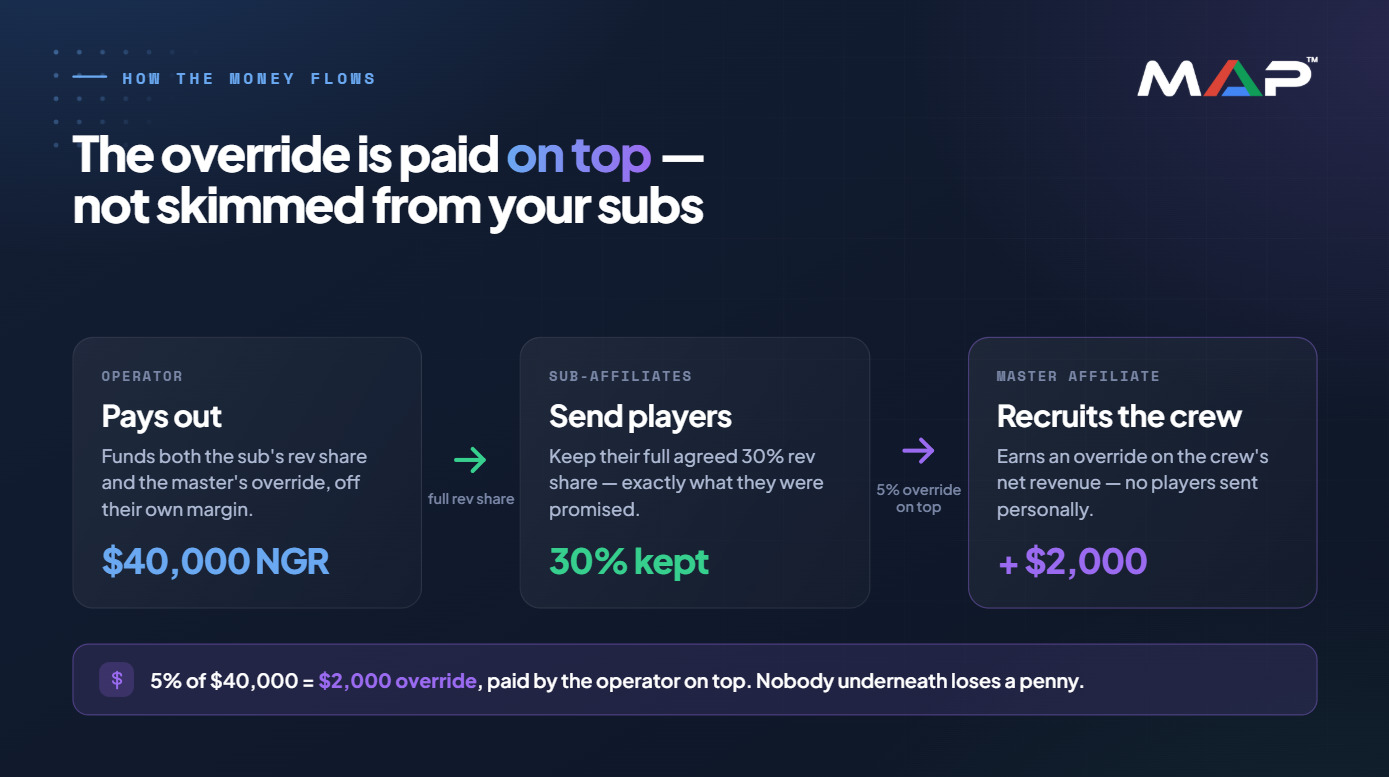
Here is the single most important thing in this whole entire article, so we are going to go nice and slow over it. In a properly run, honest structure, your override as the master does not come out of your sub-affiliate's pocket, not one single penny of it. The operator pays that overrides itself, off their own margin, because hoovering up all that lovely volume through you is still a fair bit cheaper for them than going and building a whole recruitment team from scratch.
So your sub keeps their full 30% rev share, exactly the number they were promised on day one, and you go and collect your 5% override sitting right on top of it, paid separately by the operator. Nobody underneath you loses a thing on account of you being there. That is how it is meant to run, and when a program has been set up cleanly and with a bit of good faith, that really is how it does run.
But, and it is a big fat but, not every program out there plays it quite so straight, and this is exactly where you have to go reading the fine print with your own two eyes. Some operators quietly structure the thing so the master's override gets carved straight out of the sub-affiliate's share instead of being paid on top, which turns a perfectly friendly arrangement into a quiet little skim, and the subs can usually smell that a mile off once they finally cotton on to what is happening.
So if anybody ever recruits you in under thier link, go and ask the one plain question that genuinely matters before you sign a single thing. Is the override being paid by the operator on top, or is it coming out of my cut? Honestly, the answer to that one question tells you very nearly everything you need to know about whether these people are worth your time at all.
How The Money Actually Flows, With Some Rough Numbers On It#
Let us throw a few rough numbers at the thing, because abstract talk helps nobody at the end of the day. Say you are the master and you have dragged in eight decent subs over the past year or so, proper ones, not just a couple of mates you bumped into at a conference.
Between the lot of them, they push a steady stream of players over every single month, and those subs are all sat on a normal rev share somewhere in that 25% to 40% band that most casino programs tend to run in for 2026. You, as the master, sat in the middle, have gone and squeezed a 5% override out of the operator on the net revenue your little crew brings in.(If you want the full breakdown of the underlying deal types first, we went deep on CPA vs RevShare vs hybrid in a separate guide.)
So picture that crew throwing off $40,000 of net gaming revenue in a given month, just as a round number to work with. Your 5% override on that comes out at $2,000, and it lands in your account without you having built a single landing page or bought a single click anywhere all month long. And the subs underneath you, they still go and collect their full whack out of that very same revenue pool, paid by the operator and not by you, so you have taken nothing whatsoever away from them.
You earned that two grand fair and square for the recruiting, the onboarding, and, believe us on this one, for the absolutely endless hand-holding, because there will be hand-holding, a lot of it, especially in the early days. Override percentages this year mostly tend to land somewhere between 2% and 10% of sub-affiliate net revenue, and where exactly you end up sitting on that scale depends on two things, really: how much volume your crew is pushing and how badly the operator happens to want it that particular month.
A master quietly running thirty quality subs walks into a very, very different conversation with an account manager than somebody who roped in two lads off a forum last Tuesday, and the maths compounds nicely in your favour as the crew grows, which is honestly the whole reason people get a bit hooked on this model once it finally starts rolling along under its own steam.
Why Operators Even Bother Offering This At All#
You might well be sitting there wondering why on earth an operator would happily go and hand over an extra slice they technically do not even owe anybody. Fair shout, and the answer is honestly pretty simple once you see it. Recruitment is expensive, and it is slow, as we said further up, and a good master basically becomes an outsourced acquisition team working away on their behalf.
You do the hunting, the vetting, the training, the chasing, all those late-night messages, and they just pay the override and collect the players that come rolling in. Clean little trade most of the time, and everybody walks away reasonably happy. It is also a big part of why so many operators these days would rather run their own affiliate programme than rent a bit of space on somebody else's network and hand the player relationship over to a stranger.
There is a second, quieter reason hiding under that one too, mind you. Affiliates tend to trust other affiliates a whole lot more than they will ever trust some operator's recruitment email landing cold in their spam folder. A sub brought in by a master he actually respects is far more likely to stick around, send proper decent traffic, and behave himself, because now there is a real relationship and a reputation sat on the line and nobody wants to look like a mug in front of someone they look up to.
That kind of warm, networked trust is the exact sort of thing an operator simply cannot go and buy with a banner ad, no matter how fat thier budget happens to be, so they pay the override instead and just let the network effect quietly do the heavy lifting for them.
Where It All Goes Wrong#
There is always a catch, of course, there is, and with these multi-tier structures, there are honestly a few of them lined up and waiting to ruin your month if you are not paying attention. The first one is plain old dilution and mess. The moment you have got multiple layers of people all earning off the very same stream of players, the accounting turns into spaghetti almost overnight, and you are suddenly trying to work out who earned what, off which sub, in which geo, on which product, after which bonus costs got skimmed off the top of it first.
Try keeping track of all that across thirty subs on a tired old spreadsheet, and you will be sitting there until the cows come home, and you will still go and fat-finger something somewhere along the way. This is far and away the single biggest practical headache of running a master crew, and honestly, it is the reason so many people quietly give the whole idea up after about six months of it.
The second problem is fraud risk, and this one is genuinely no joke in 2026. Multi-tier structures are sadly a lovely little hiding spot for bonus abusers and fake-traffic merchants, because a dodgy master can go and stuff his crew full of junk sub-accounts and quietly wash low-quality or flat-out fraudulent volume up through the override layer to separate it a bit from the original source. Operators have wised up to this game, though, which means that if you are running a clean and honest network, you now carry a real burden of proving your subs are clean, and that is just the way of it now. And here is the part that really stings: one single bad apple sub can get your entire crew flagged and frozen while they go off and investigate the lot of you, so who you let in through the door genuinely matters a lot.
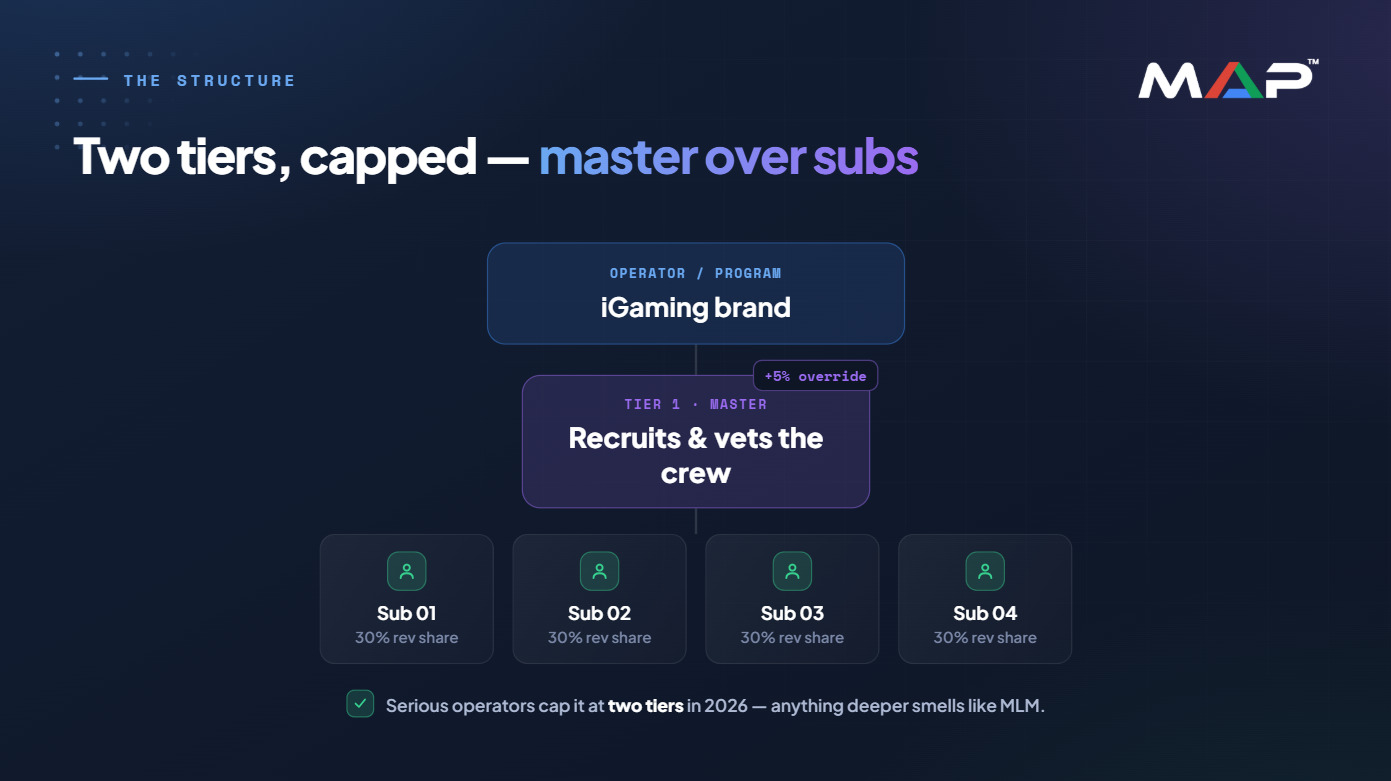
The third issue is the regulatory optics of the thing. Stacked-tier commission structures start looking uncomfortably close to multi-level marketing the second you get past two or three layers deep, and regulators in the tightly run markets really, truly do not like the smell of that one bit. So most serious operators these days quietly cap the whole thing at two tiers, full stop, master and sub, and that is your lot.
If anybody ever comes pitching you a program with five or six layers of override piled up on top of each other, that is not some clever opportunity knocking on your door; that is a fire alarm going off, and you should go and walk away from it without so much as looking back over your shoulder.
And the fourth one, creeping up quietly behind all the others, is plain quality control. Your override is only ever as good as the subs sat there cranking it out for you, and if you go recruiting lazy or low-skill affiliates, you will end up burning all your hours chasing dead weight around for peanuts. The override looks an awful lot like passive income from across the room, but get up close to it and it is nothing of the sort, and anybody who has actually run a crew themselves will happily tell you the very same thing.
The 2026 Stuff That Has Genuinely Shifted#
A handful of things have honestly moved this year compared to even a couple of short years back, and they change the way you ought to be leaning on all of this. Operators are picking over sub-networks far harder than they ever used to. Affordability checks, source-of-funds rules, tighter advertising regulation right across the UK, Germany and the Netherlands and bits of Australia too, all of it means operators are under genuine pressure now to know exactly who is sending them players and how.
A master who cannot account cleanly for every single sub on his books is a compliance liability these days, not just a handy acquisition channel, and operators are quietly cutting loose the ones who cannot go and show their working when asked. A bit brutal, sure, but there it is.
Transparency has basically gone non-negotiable on top of that[cite: 76]. Both sides of it, the operators and the subs alike, now fully expect live, accurate, tier-aware reporting, and the old days of a master sat quietly in the middle, massaging all the numbers by hand are pretty much done and dusted. The subs want to go and eyeball thier own figures their own selves, the operators want to verify the override being paid is actually legit, and everybody wants to see the very same truth on the very same screen at the very same time, which honestly is a really healthy shift for the whole industry even if it does make life a touch fiddlier for the poor master in the middle.
And the tooling expectation has jumped right up along with all of it. Trying to run a serious multi-tier crew off spreadsheets and a bit of goodwill in 2026 is a fast lane straight to errors, disputes, and a frozen account, no two ways about it. The networks genuinely thriving this year are, almost without exception, the ones running on proper software that goes and tracks every single tier automatically, which, handy or not, drops us neatly onto the next bit of the whole thing.
So, How Do You Actually Track The Whole Thing#
Here is the honest truth of it, with no sugar sat on top. Multi-tier structures live or die entirely on the quality of the tracking underneath them, full stop. The whole model leans on knowing, accurately and in real time, which player came in from which sub, how much net revenue that player threw off, and exactly what override that produces for the master once all the operator's various deductions have been taken off the top.
Get any of that even slightly wrong and you get disputes, and disputes in this game have a nasty old habit of quietly ending relationships that took you years and years to go and build up in the first place[cite: 85]. This is the exact gap that proper affiliate program software exists to close for you.
Over here at Mediacle, we built MAP to handle these multi-tier crews properly from the ground up, so the override calculation just quietly happens itself, automatically, and everybody up and down the chain gets to see the very same numbers. The master sees their crew performance broken right down by sub, by geo, by product. The sub sees their own clean figures with no fog sat in the middle and no funny business going on.
And the operator sees the whole tree laid out and can check that every single override being paid out is sitting on top of genuine, traceable, non-fraudulent volume, the very same data discipline that lets a good program weigh FTD value against real lifetime value instead of just guessing. Nobody up or down the line has to take anybody else's word for anything, which, when you stop and think on it for a second, is exactly how a healthy network really ought to run.
Strip that kind of visibility out of the picture and a master structure quietly turns into a trust exercise balanced on top of a spreadsheet, and trust exercises balanced on spreadsheets have a way of toppling clean over at the very worst possible moment, usually right about when the money has finally got big enough to actually be worth arguing over. Pour proper tier-aware tracking underneath the thing instead and it can grow as large as you can possibly recruit, with the accounting just quietly ticking away in the background while you go and get on with the rest of your life.
It also helps no end to keep half an eye on the wider numbers while you are at it, and we keep a running list of the 14 KPIs every iGaming affiliate manager should track if you fancy a proper look. That, right there, is honestly the real lever to pull on all of this in 2026.
How To Set Yourself Up Without Falling Flat On Your Face#
So you are sat there thinking about mastering yourself, then? Right, here is the honest little checklist on doing the thing with your eyes properly open rather than just blundering in headfirst.
- Pick clean operators. Go with a clean, two-tier setup where the override is paid on top by the operator, not quietly skimmed out of your subs, becuase that one single choice on its own protects every relationship you are about to go and sweat blood building up.
- Vet every single sub before you let them in. Properly and carefully, because their traffic quality becomes your headache the very second they sign up underneath you, and one fraud-happy chancer really can go and freeze the whole lot of you. Recruit slow, recruit clean, no two ways about it whatsoever.
- Get your tracking sorted before you scale, not after. Bolting accurate multi-tier reporting onto a crew you have already gone and grown is genuinely miserable work, and you will quietly haemorrhage good subs to disputes the entire time you are sat there trying to fix it.
- Push for a fair override once you have got real volume to bargain with. Somewhere in that 2% to 10% band we talked about, and just let the sheer size and reliability of your crew do most of the talking for you across the table.
- Be straight with your subs about how the whole thing works. A crew built quietly on skimming falls apart the very second one of them works out what is going on, and word travels at the speed of light in this industry, fair is fair.
Pulling It All Together#
Master and sub-affiliate structures are honestly one of the most underrated ways there is to scale an affiliate business in 2026, but only, and we really do mean only, if you go into the thing with your eyes wide open. The override is real money, and the network effect underneath it is genuinely powerful stuff, but the model only ever rewards the people who go and recruit clean, track properly, and stay straight with everybody up and down the chain.
Do it on a spreadsheet and a handshake, and you are quietly building the whole thing on sand. Do it on proper tier-aware tracking instead, and you are building something that may possibly keep paying you nicely for years. So if you have genuinely got the recruiting instinct in you and the patience to go and grow a crew the right way, this is a model well worth a proper look this year.
Just go and sort the tracking out first, vet your people hard, and never, ever trust a structure you cannot actually see the whole way down. If you fancy seeing exactly why operators move over to MAP once they outgrow the spreadsheets, go and have a proper poke around the full feature set, or just book a demo with the team and run it on your own traffic for a bit. That is honestly the only way you will ever really know for sure.
Frequently Asked Questions#
In a properly run, clean program, no it does not. The operator pays the override off their own margin, separately, and you go and keep your full agreed rev share exactly as promised. But some programs out there do quietly carve it out of the sub's slice instead, so you should always go and ask that plain question before you sign anything at all. The answer tells you alot about whether these people respect you or just see you as a number on a spreadsheet.
Most legitimate iGaming operators cap it at two tiers in 2026, master and sub and no further, mainly because going any deeper than that starts to whiff of multi-level marketing and makes the regulators twitchy. So if somebody is dangling five or six stacked layers in front of your face, you really want to treat that as a warning sign rather than as some winning lottery ticket.
Not really, if we are being totally honest with you here. The override looks lovely and passive from a distance, but you are quietly carrying all the recruiting, the vetting, the onboarding and a fair old chunk of ongoing babysitting on top. It is far closer to running a little agency than it is to collecting rent off a flat. It can absolutely be very rewarding, no question, but it is real work, especially in those early days when nothing is automated yet and you are doing the lot by hand.
Because multi-tier accounting gets hairy really fast, and the price of getting it wrong is broken trust and frozen accounts, neither of which you want. Proper software works out every single override itself and shows the master, the sub, and the operator the very same numbers in real time. Tools like MAP exist for exactly this reason: to keep multi-tier tracking accurate and transparent so the whole crew can grow without the maths quietly collapsing underneath everybody.